

Main content 1 Menu 2 Search 3 Footer 4
+A
A
-A
High contrast
HOME JOURNAL JOURNAL SELECTION NETWORK HELP ABOUT

Journal Selection Criteria and Standards

WPRIM Journal Selection Criteria (August 2023)

NJSC Philippines Selection Criteria (for Philippine-based journals only)

Minimum standards for the suspension and removal of WPRIM approved journals

Application and Indexing Process

Application and Submission Process for WPRIM Indexing

Journal Content Management

Candidate Journal Selection and Data Creation and Management System

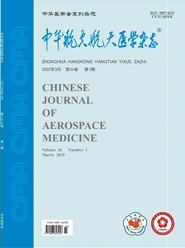
Chinese Journal of Aerospace Medicine

1990  (1,  1)  to  Present  ISSN: 1007-6239

Articles

About

Save Email

Sort by

Best match
Relevance
PubYear
JournalTitle

DISPLAY OPTIONS

Format:

Per page:

Save citations to file

Selection:

Format:

Create file Cancel

Email citations

To:

Please check your email address first!

Selection:

Format:

Send email Cancel

1474

results

page

of 148

1

Cite

Cite

Copy

Share

Share

Copy

Effect of smoking on movement time of the fighter pilots in increasing power bicycle exercise

Jiaojie LI ; Xiaojian CHEN ; Wei HUANG ; Xiangwu FEI ; Xue LI ; Xiaoping CHEN ; Jun WANG ; Jianhua XU

Chinese Journal of Aerospace Medicine.2022;33(1):45-48. doi:10.3760/cma.j.cn113854-20210311-00046

Objective:To explore the quantitative effect of smoking on pilots′ physical fitness.Methods:According to smoking index, 215 fighter pilots were chosen as subjects and divided into non-smoking group (143 cases), low smoking-index group (23 cases), moderate smoking-index group (20 cases) and high smoking-index group (29 cases). Subjects were asked to rest on the power bicycle for 3 min, then start warm up at a speed of 60 r/min (no-load, low-level exercise at 60 r/min) for 3 min, and then execute continuously exercise at a constant speed with a power increase of 25 W/min. The load exercise was stopped immediately when the maximum exercise level was reached. Age and body mass index (BMI) were recorded, and cardiopulmonary function indexes such as exercise time, exercise power and respiratory exchange rate (RER) were measured.Results:There was no significant difference on age, BMI and RER among the 4 groups ( P>0.05), but there were significant differences in exercise time and exercise power ( F=6.02, 6.25, P=0.001, P<0.001). Under the condition of the same RER, the exercise time and exercise power of the moderate and high smoking-index group (472.1±54.6 s, 456.9±60.4 s and 197.2±23.1 W, 190.2±24.4 W) were significantly less than those of the non-smoking group (506.3±65.5 s and 211.1±26.9 W) ( P<0.05). Conclusions:This study showed that the exercise time and exercise power of moderate and high smoking-index pilots in increasing power bicycles were significantly lower than those of non-smoking pilots. If the pilots were with moderate-high smoking index their cardiopulmonary function would be affected.
2

Cite

Cite

Copy

Share

Share

Copy

Research progress on Schmorl′s nodes of lumbar spine in flying personnel

Jianxing XIA ; Junling WANG ; Yanxiang GUO ; Wen ZHANG ; Hongmin YANG ; Wei WEI ; Bingjie JIA

Chinese Journal of Aerospace Medicine.2022;33(1):59-62. doi:10.3760/cma.j.cn113854-20210528-00079

Objective:To provide ideas and references for improving the lumbar stability of flying personnel by reviewing the research progress and tendency on Schmorl′s nodes of lumbar spine in flying personnel. Literature resource and selection Relevant papers and monographs about Schmorl′s nodes published at home and abroad. Literature quotation Thirty-six published references were cited. Literature synthesis It is generally considered that Schmorl′s nodes of lumbar spine are cartilaginous nodes formed by the herniation of the intervertebral discs tissue into the vertebral body through the broken cartilaginous endplates. There are different opinions on the epidemiology and pathogenesis of Schmorl′s nodes of lumbar spine. Because most of them have no obvious clinical symptoms, they were once considered to be of no research value. However, the investigation showed that the further study on Schmorl′s nodes of lumbar spine in flying personnel is realistic. Schmorl′s nodes of lumbar spine may not only cause lumbago, but also are closely related to lumbar intervertebral discs degeneration. The formation of Schmorl′s nodes of lumbar spine in flying personnel will affect the viscoelasticity of lumbar intervertebral discs, and this will affect their anti-G and anti-vibration abilities, accelerate the degeneration of lumbar spine and intervertebral discs, and induce clinical symptoms or reduce flight endurance. Conclusions:Schmorl′s nodes of lumbar spine are closely related to lumbar disc degeneration and lumbar instability. Schmorl′s nodes are commonly seen in the lumbar spine and have an important effect on the overall stability of lumbar spine of flying personnel.

3

Cite

Cite

Copy

Share

Share

Copy

Study on the relationship among fatigue, social support and trait anxiety of military flying personnel

Chuanyong LIU ; Jinfeng SUN ; Zhenshan LOU ; Tao XU

Chinese Journal of Aerospace Medicine.2022;33(2):65-70. doi:10.3760/cma.j.cn113854-20210623-00096

Objective:To explore the influences of trait anxiety and social support on fatigue and the mediating role of trait anxiety, and to provide data support for maintaining mental care of military flying personnel.Methods:One hundred military flying personnel in recuperation were randomly selected according to the method of random numder table. Fatigue Scale-14 (FS-14), Trait Anxiety Inventory (T-AI) and Perceived Social Support Scale (PSSS) were used to analyzed the influences of trait anxiety and social support on fatigue.Results:Different ages, years of military service, flying hours, military rank, marital status, educational level and only child or not had no statistical significance on fatigue (all P>0.05). Fatigue was positively correlated with trait anxiety ( r=0.412, 0.311, both P<0.001), but negatively correlated with social support ( r=-0.247, -0.236, -0.226, -0.314, -0.337, -0.235, P=0.013, 0.018, 0.024, 0.001, 0.001, 0.019). Trait anxiety was negatively correlated with social support ( r=-0.345, -0.350, -0.325, P<0.001,<0.001, P=0.001). Trait anxiety not only had a direct path effect on fatigue ( β=0.423, 0.246, P<0.001, P=0.012), but also had an indirect path effect as a mediator of social support on fatigue ( β=-0.143, -0.088, P=0.026, 0.037). Conclusions:Fatigue of military flying personnel is influenced by trait anxiety and social support, and trait anxiety plays a multiple intermediary role in such influences.

4

Cite

Cite

Copy

Share

Share

Copy

A preliminary study on the effect of pilots′ arousal adjustment ability training

Yan ZHANG ; Yishuang ZHANG ; Yang LIAO ; Duanqin XIONG ; Jian DU ; Rong LIN ; Liu YANG

Chinese Journal of Aerospace Medicine.2022;33(2):71-76. doi:10.3760/cma.j.cn113854-20210727-00111

Objective:To investigate the effectiveness of pilot′s arousal adjustment ability training.Methods:Thirty-five pilots were divided into test group (18 cases) and control group (17 cases) according to the order of entering Air Force Healthcare Center for Special Services, Dujiangyan. In the same simulated flight task, the test group conducted the trained method to adjust arousal ability, while the control group took the deep breathing relaxation method for self-regulation. For analyzing the effects of arousal adjustment training, the physiological and psychological indicators, scores of subjective scale and flight performance were compared between groups and the formal 2 were also compared between before and after the simulated flight task.Results:①During the simulation flight task, the test group had significantly higher EEG α wave amplitudes than the control group ( Z=2.36, 2.16, 1.96, P=0.008, 0.015, 0.025). ② Profile of Mood States Scale indicated that the scores of tension and energy in test group after task were higher than those before task ( t=2.32, 2.66, P=0.033, 0.017); the scores of tension and panic before the task were significantly lower than those in the control group ( t=2.20, 2.23, P=0.042, 0.032), and the scores of fatigue and total mood disturbance (TMD) after the task were significantly lower than those in the control group ( t=2.27, 2.39, P=0.035, 0.023). The self-evaluation score of arousal in test group was significantly higher than that in control group after the task ( t=2.16, P=0.040). ③The scores of four-fold task in the simulated flight task in test group were statistically higher than that in control group ( t=2.11, P=0.043). Conclusions:Through daily arousal adjustment ability training, pilots can obtain and remember "the best state" of the previous flight, and improve their technical capabilities to the best level when performing the flight tasks.

5

Cite

Cite

Copy

Share

Share

Copy

Investigation on qualification criteria of age, flying hours and personality characteristics among test pilots

Jin WANG ; Jiajia LIU ; Chuan YU ; Jing WU ; Jianlin QI

Chinese Journal of Aerospace Medicine.2022;33(2):77-81. doi:10.3760/cma.j.cn113854-20210709-00100

Objective:To investigate the qualification criteria of age, flying hours and personality characteristics among test pilots, and to provide theoretical foundation on development of test pilots qualification strategies.Methods:Thirty-six test pilots were randomly selected to complete Cattell's 16 Personality Factor (16PF) and Minnesota Multiphasic Personality Inventory(MMPI) assessments. They were divided into 30-39 years group and 40-49 years group. The 16PF and MMPI scores were compared between different age groups. Among which, 30 test pilots, who were experienced test flight for over 2 500 h, were selected for semi-structure interview to sample their opinion on the requirements of age and flying hours of being a test pilot.Results:The statistic of interview showed that the age and flying hours requirements of fighter test pilots would be 30-35 years old and >1 000 h respectively, while 30-35 years old and unrestricted flying hours for the test pilots of bomber and transporter. The selection should meet the physical requirements of high-performance fighter pilots for those 2 kinds of test pilot. In MMPI assessments, correction scale scores of the test pilots in 30-39 years group were significantly lower than those in 40-49 years group ( U=97.50, P=0.040), but their schizophrenia scale scores were significantly higher than those in 40-49 years group ( U=95.50, P=0.035). There was no significant difference between groups in other personality scales (all P>0.05). Conclusions:The test pilots for different aircraft types ask for different flying hours requirements. Even the fighter and bomber/transporter ask for test pilot′s different flying hours requirements, but due to the insignificance on personality characteristics between different age groups, it would be necessary to investigate further on the selection criteria for different age segments.

6

Cite

Cite

Copy

Share

Share

Copy

Physiological evaluation of the performance of aircrew oxygen system for a military transport aircraft by altitude chamber test

Dongqing WEN ; Guiyou WANG ; Zhao GU ; Lihao XUE ; Lihua YU ; Lei TU ; Weiru SHI ; Yan ZHANG ; Dongchen YIN ; Xiaopeng LIU

Chinese Journal of Aerospace Medicine.2022;33(2):82-87. doi:10.3760/cma.j.cn113854-20210323-00057

Objective:To evaluate the protection performance of military transport aircraft oxygen system for aircrew and provide the physiological tests basis for product design finalization.Methods:Four dummies and 4 healthy volunteers who were equipped with individual protection equipment and military transport aircraft oxygen system completed 4 tests in altitude chamber including the oxygen supply performance physical test of oxygen system, the rapid decompression physical test of oxygen system, the physiological tests of oxygen continuously supplying for 6 h and oxygen supply performance test in rapid decompression at 12.0 km. Oxygen concentration, respiratory resistance, safety pressure, peak value, peak duration and steady pressure of mask under rapid decompression were tested. Electrocardiograph and oxygen saturation of volunteers were monitored.Results:The oxygen partial pressure provided by military transport aircraft oxygen system under 12.0 km was ≥19.1 kPa corresponding to the respiration ventilation volume of 20 L/min of dummy. The expiratory resistance was no higher than 441.3 Pa and the inspiration resistance was no higher than 490.3 Pa before the safety pressure connected. The peak pressure value in rapid decompression with 1.0 L lung volume of dummy was no higher than 5.8 kPa. The oxygen partial pressure provided by military transport aircraft oxygen system for volunteers was over 21.9 kPa in the 6 h cruising flight. All 4 volunteers successfully completed the rapid decompression physiological tests at 12.0 km with good subjective and objective responses.Conclusions:The protection performance of military transport aircraft oxygen system for aircrew can provide enough protection against the hypoxia up to 12.0 km

7

Cite

Cite

Copy

Share

Share

Copy

Investigation of cervical and lumbar muscle exercise and prevalence of cervical and lumbar spine in Air Force flying personnel

Ying LIU ; Jiakang ZHANG ; Dongrui YU ; Andong ZHAO ; Xiaojun XU ; Lili ZHANG ; Fang SU ; Lin LIU

Chinese Journal of Aerospace Medicine.2021;32(2):65-69. doi:10.3760/cma.j.cn113854-20200430-00049

Objective:To explore the relationship between the exercise of cervical and lumbar muscles of military flying personnel and the prevalence of cervical and lumbar spine diseases, and to verify the protective effect of the exercise of cervical and lumbar muscles on cervical and lumbar of flying personnel.Methods:A self-made questionnaire and cluster sampling method were used. Air Force pilots of different aircraft types were selected to survey the situation of physical exercise and the prevalence of cervical and lumbar diseases by a questionnaire. Pilots were grouped by if stretching before flight, if relaxing after flight, and if regularly exercising on the strength of cervical and lumbar muscles. The prevalence of the cervical and lumbar diseases was compared. Influence factors were searched by Logistic regression analysis to investigate the protective effect of cervical and lumbar muscle exercise on the neck and waist.Results:In this study, 779 valid questionnaires out of 923 were obtained. The effective rate of the questionnaires was 84.4%. The prevalence of cervical and lumbar diseases in the flying personnel without cervical and lumbar muscles stretching before flight was 36.2%, while the prevalence of flying personnel with cervical and lumbar muscles stretching before flight was 27.6%. There were significant differences between them (χ 2=6.217, P<0.05). The prevalence rate of cervical and lumbar diseases in the flying personnel without cervical and lumbar muscles relaxation after flight was 37.9%, while the prevalence of flying personnel without cervical and lumbar muscles with relaxation after flight was 23.7%. There were significant differences between them (χ 2=16.30, P<0.01). The prevalence rate of cervical and lumbar diseases in the flying personnel without regular training was 41.1%, while the prevalence of relaxation after flight was 29.8%. There were significant differences between them (χ 2=8.89, P<0.01). Logistic regression analysis showed that age, relaxing after the flight, and regular training of cervical and lumbar muscles were all independent factors that affected cervical and lumbar diseases. Among them, increased age was the risk factor of cervical and lumbar diseases ( OR=1.073, 95 %CI: 1.033-1.114, P<0.01), cervical and lumbar relaxing after the flight ( OR=0.456, 95 %CI: 0.303-0.686, P<0.01) and regular training of cervical and lumbar muscles ( OR=0.656, 95 %CI: 0.463-0.930, P<0.05) were both protective factors for cervical and lumbar diseases. Conclusions:The stretching before flight, relaxing after flight, and regular training of cervical and lumbar muscles can significantly reduce the prevalence of cervical and lumbar diseases in flying personnel.

8

Cite

Cite

Copy

Share

Share

Copy

Analysis on temporary grounding in the flying personnel

Lulu DONG ; Xiaoxiao WU ; Wei WANG ; Chengxiang XIAO ; Qingming LYU ; Dan ZHANG

Chinese Journal of Aerospace Medicine.2024;35(4):281-285. doi:10.3760/cma.j.cn11385420240131-00009

Objective:To discuss the aeromedical support enhancement measures by analyzing the disease spectrum and the aeromedical characteristics of temporarily grounded flying personnel.Methods:A retrospective analysis was conducted on the clinical data of 244 flying personnel who received medical treatment at the Southern Theater Air Force Hospital from November 2011 to March 2023 and were temporarily grounded in aeromedical assessment. The flying personnel were grouped by aircraft types (fighter, trans-bomber, helicopter) and flying hours (<2 000 h and ≥2 000 h), and the spectrum of temporarily unqualified flight diseases were statistically analyzed. The disease distributions of flying personnel in different aircraft types and flying hours were compared.Results:Among the 244 flying personnel (389 person-time) who were identified as temporarily grounded by aeromedical assessment, the major specialties involved were surgery (52.5%), internal medicine (24.6%) and neuropsychiatry (14.3%). The top 10 diseases leading to temporarily grounded were cervical and lumbar spine diseases, anxiety-depression, knee joint injury (surgical treatment), anal fistula (surgical treatment), sleep disorders, joint and soft tissue injuries, hypertension, ureteral stones, achilles tendon rupture and fracture (conservative treatment). There was a significant difference in the proportion of flying personnel temporarily grounded due to anxiety-depression among different aircraft types ( P=0.014). There were no significant differences in other diseases among flying personnel in different aircraft types (all P>0.05). The proportion of temporarily grounded flying personnel due to knee joint injury in flying hours <2 000 h was higher than that in flying hours ≥2 000 h, and the difference was significant ( χ2=4.47, P=0.035). Among the 71 flying personnel who underwent repeated ground observation, 28 were identified as qualified, 22 were grounded and 21 were still temporarily grounded. Conclusions:The proportion of flying personnel temporarily grounded due to diseases is relatively high. Accurate diagnosis and treatment of diseases and aeromedical assessment are important links to promote the early return of flying personnel.

9

Cite

Cite

Copy

Share

Share

Copy

The value of artificial intelligence model based on CT imaging in the differential diagnosis of kidney stones in civil aviation pilots

Bin LIU ; Jianfei LI ; Xiaokun ZHANG ; Ying ZHANG ; Haifeng ZHU

Chinese Journal of Aerospace Medicine.2024;35(4):286-289. doi:10.3760/cma.j.cn113854-20231224-00136

Objective:To accurately identify kidney stones and renal papillary calcification in civil aviation pilots by using an artificial intelligence model based on CT imaging.Methods:The imaging data of 135 civil pilots with kidney stones or renal papillary calcification confirmed by flexible ureteroscope who underwent urinary CT examination in Civil Aviation General Hospital from August 2015 to May 2021 were retrospectively analyzed. Preoperative CT images of all patients were analyzed blindly by 2 radiologists and recall and accuracy rates were calculated. Pilots with kidney stones and renal papillary calcification were randomly assigned as the training set and test set in a ratio of 4∶1 respectively. An artificial intelligence model was constructed based on preoperative CT plain scan images of training set. The test set was used to detect the model and calculate the recall rate and accuracy rate of the final model in the diagnosis of the 2 types of lesions.Results:Data from 86 pilots with kidney stones and 49 pilots with renal papillary calcification were used to build the model and the training iteration of model establishment was stopped at the 50th time. The final results of the model interpretation test set showed that the recall rate and accuracy rate diagnosing kidney stones was 87.58% and 97.17%, respectively, and the recall rate and accuracy rate diagnosing renal sinus calcification was 96.07% and 92.83%, respectively, and the accuracy rate of the model in diagnosing kidney stones and renal sinus calcification was 96.57%.Conclusions:The artificial intelligence model based on CT imaging has a certain clinical value for the rapid and accurate determination of kidney stones and renal papillary calcification by air crew examiners in civil aviation.

10

Cite

Cite

Copy

Share

Share

Copy

Investigation on the mental health status of civil aviation pilots after public emergency event and aeromedical support measures

Jinyang HE ; Xiaoli WANG

Chinese Journal of Aerospace Medicine.2024;35(4):290-293. doi:10.3760/cma.j.cn113854-20240329-00041

Objective:To provide references for aeromedical support by understanding the psychological status of civil pilots after public emergencies, analyzing the psychological impact of public emergencies on civil pilots, and exploring the countermeasures that airlines can take.Methods:After an airline public emergency event, 183 active pilots of an airline company were randomly selected as the subjects, the psychological status of the subjects was evaluated by questionnaire survey on April 9, 2022. General information and Depression Anxiety and Stress Scale (DASS-21) scores of the subjects were collected. The pilots were grouped by age (<30 years, 30-39 years, ≥40 years), marital status (married, single), flight position (captain, co-pilot), total flying hours (<7 000 h, 7 000-13 999 h, ≥14 000 h) and flying hours in 2021 (<300 h, 300-599 h, ≥600 h). The DASS-21 subscale scores of each group were compared.Results:All 183 distributed questionnaires were valid, yielding a 100% response rate and full survey coverage. Comparison of DASS-21 subscale scores among civil aviation pilots of different ages, marital statuses, flight positions, total flying hours, and flying hours in 2021, with no significant differences (all P>0.05). The subscale result of DASS-21 showed that the stress subscale of 26 cases were mild, 9 cases were moderate, and the detection rate of stress state was 19.1%. The anxiety subscale results of 6 cases were mild, 15 cases were moderate, and 1 case was severe, and the detection rate of anxiety state was 12.0%. The depression subscale results of 10 cases were mild, 6 cases were moderate, and the detection rate of depression was 8.7%. Conclusions:After encountering public emergencies, the detection rates of pilots with stress, anxiety and depression state is relatively low, indicating that the overall mental health status of pilots is good. Appropriate aeromedical support measures (the improvement of the company′s emergency management system, the establishment of a psychological management platform, the strengthening of health education work, the enrichment of cultural and sports activities, and the optimization of fatigue management) can help pilots maintain a stable psychological state.

Country

China

Publisher

Chinese Medical Journals Publishing House Co. Ltd.

ElectronicLinks

https://zhhkhtyxzz.yiigle.com

Editor-in-chief

Zhengxue Luo

E-mail

hkbjb@sina.com

Abbreviation

Chin J Aerospace Med

Vernacular Journal Title

中华航空航天医学杂志

ISSN

1007-6239

EISSN

Year Approved

2025

Current Indexing Status

Currently Indexed

Start Year

1990

Description

About Chinese Journal of Aerospace Medicine The aim of Chinese Journal of Aerospace Medicine is to combine theory and practice, improve and popularize, actively advocate a hundred flowers bloom and a hundred schools of thought contend, advocate seeking truth from facts, promote the development of the related disciplines of aerospace medicine and human efficiency, and promote the exchange and penetration of aerospace medicine and human efficiency with other biomedical and engineering specialties. It has been indexed by Scopus, Chinese Scientific and Technical Papers and Citations (CSTPCD), World Journal Clout Index (WJCI) and China National Knowledge Infrastructure (CNKI). Audience Senior and intermediate professionals who specialize in aerospace medicine and human efficiency. Subject Coverage Original articles, short articles, aeromedical practices, case reports, aeromedical support, reviews, commentary, monograph, international conference exchange, profile narrative, academic lectures, readers' opinions and news reports on aerospace and human efficacy and related marginal disciplines. Topics of interest for Chinese Journal of Aerospace Medicine include: -The content of the journal belongs to the discipline of special medicine and military medicine, with the characteristics of multidisciplinary synthesis and cross-penetration, and mainly reflected in the aerospace industry, aerospace flight safety and efficiency, as well as the synthesis of special medicine, preventive medicine, environmental medicine, psychology, etc. -Military aeromedicine (Air Force, Navy and Army aeromedicine) and civil aeromedicine, with a balance of aerospace medicine are the strengths of the journal. -The change in aerospace medicine from a focus on promoting physiological compensatory adaptations to enhancing human performance under extreme environmental conditions is what the journal is helping to promote. -The expansion of manuscripts in high altitude medicine is also a special emphasis of the journal.

Related Sites

WHO WPRO GIM

Help Accessibility
DCMS Web Policy
CJSS Privacy Policy

Powered by IMICAMS( 备案号: 11010502037788, 京ICP备10218182号-8)

Successfully copied to clipboard.