

Main content 1 Menu 2 Search 3 Footer 4
+A
A
-A
High contrast
HOME JOURNAL CRITERIA NETWORK HELP ABOUT

Current criteria:

Regional:

WPRlM journal selection criteria(2023)

Minimum standards for the suspension and removal of WPRIM approved journals

Countries journal selection criteria:

Philippines

Submit your journal information>

Contact NJSCs>

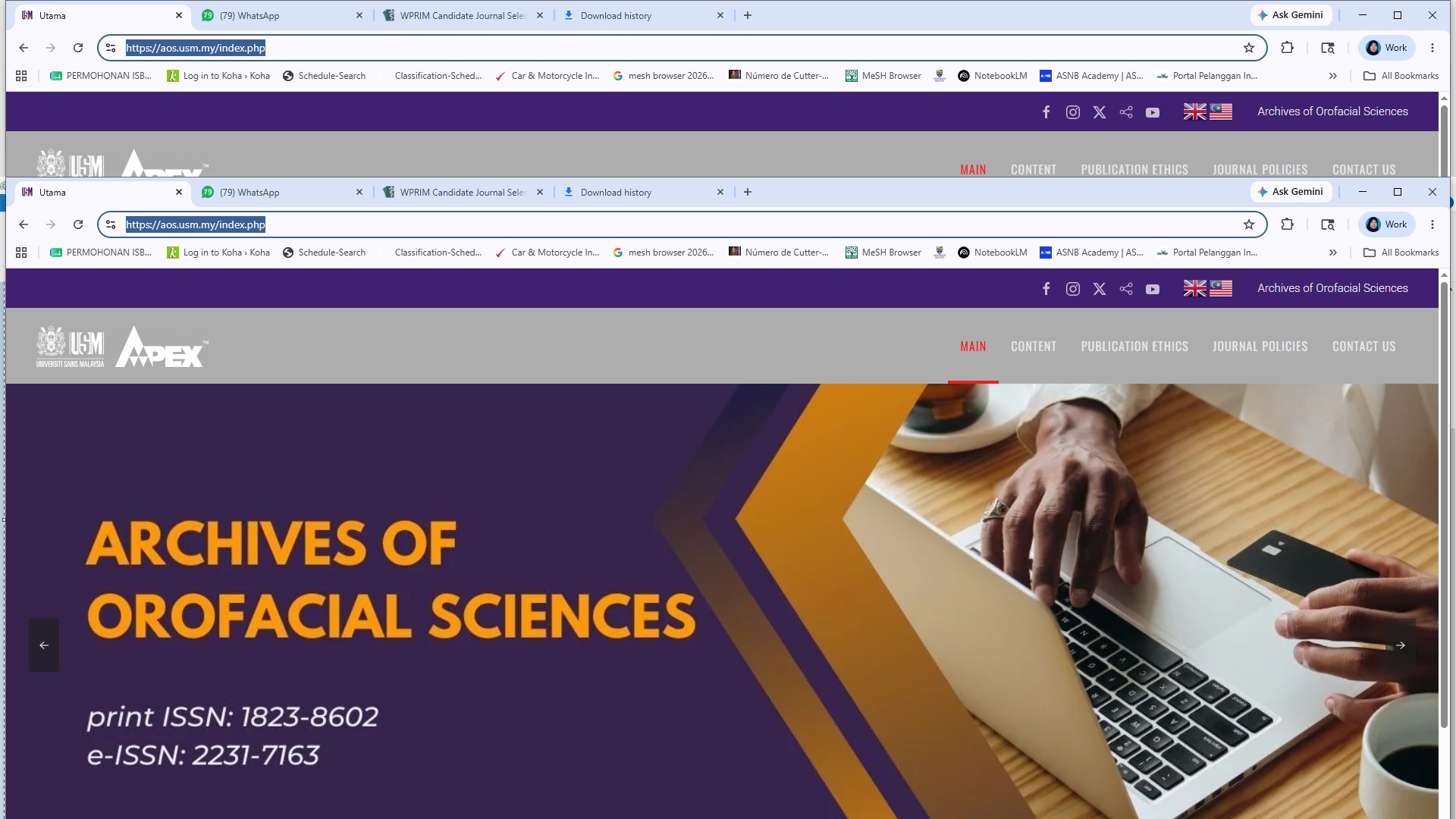
Archives of Orofacial Sciences

2002 (v1, n1) to Present ISSN: 1671-8925

Articles

About

Year of publication

Save Email

Sort by

Best match
Relevance
PubYear
JournalTitle

DISPLAY OPTIONS

Format:

Per page:

Save citations to file

Selection:

Format:

Create file Cancel

Email citations

To:

Please check your email address first!

Selection:

Format:

Send email Cancel

268

results

page

of 27

1

Cite

Cite

Copy

Share

Share

Copy

Periodontal Disease in Patients with Type 2 Diabetes and Its Relationship with Dry Mouth Condition

Norsila Abdul Wahab

Archives of Orofacial Sciences.2019;14(2):77-86. doi:10.21315/aos2019.14.2.380

This study aimed to determine the prevalence and severity of chronic periodontitis (CP) and the relationship between periodontal status and dry mouth condition in patients with type 2 diabetes mellitus (T2DM). A cross-sectional study was conducted on 66 controlled T2DM patients, determined by HbA1c level ≤ 9%. Plaque index (PI), gingival index (GI), periodontal pocket depth (PPD), and clinical attachment loss (CAL) were recorded. Subjects were given questionnaire for self-evaluation of dry mouth followed by collection of saliva. Data were analysed using SPSS version 22.0. Results showed that the prevalence of CP was 93.9% with severity ranging from mild (41.9%), moderate (30.6%), to severe (27.5%). Most subjects (74.2%) had normal stimulated salivary flow rate although 15.9% reported having less saliva. There was no significant association between periodontal parameters and salivary flow rate. In conclusion, T2DM patients exhibited high prevalence of CP despite having controlled glycaemic status. Dry mouth condition was not a common symptom and was also not associated with periodontitis. To ensure appropriate management of diabetics, collaboration between medical colleagues and dental practitioners is important to control progression of periodontal disease.
2

Cite

Cite

Copy

Share

Share

Copy

Fatty Acid Evaluation and Antimicrobial Activity of Virgin Coconut Oil and Activated Virgin Coconut Oil on Streptococcus mutans

Ummi Aqilah Haron

Archives of Orofacial Sciences.2019;14(2):87-98. doi:10.21315/aos2019.14.2.359

For decades, coconut oil was reported to possess a broad spectrum of antimicrobial activity due to its abundant fatty acid’s contents. Streptococcus mutans (S. mutans) has been strongly implicated as the main etiological factor in dental caries. Regardless of the ongoing medical advances, the therapeutic resources for dental caries remain ineffectual, and this has led to renewed interest in using virgin coconut oil (VCO) as a possible choice for dental caries control. In this study, the ability of VCO and activated virgin coconut oil (AVCO) combatting cariogenic S. mutans ATCC 25175 has been evaluated. Fatty acids contents were compared through gas chromatography-mass spectrum (GC-MS) analysis, and their antimicrobial activity was determined using disc diffusion and minimum inhibitory concentration (MIC) test. From the GC-MS analysis, AVCO (59%) was found to have a slightly higher medium-chain fatty acids (MCFA) as compared to VCO (54.1%), and the long-chain fatty acids (LCFA) contents in VCO (45.9%) was found to be higher than AVCO (41%). Interestingly, S. mutans ATCC 25175 was found to be susceptible towards AVCO (MIC: 6.24 mg/ml) and resistance towards VCO in vitro. The excellent antimicrobial activity of AVCO as a result from (i) the release of individuals fatty acids after activation of VCO by lipase digestion and (ii) the present of MCFA and LCFA that are significant in antimicrobial activity. Further study can be designed to specifically examine the activity of individuals fatty acids present in oils against S.mutans virulence genes/protein using molecular dynamic assessment.

3

Cite

Cite

Copy

Share

Share

Copy

A Pilot Study of Preparedness for Medical Emergencies in Urban Private Dental Practices in Malaysia

Nalisha Mohamed Ramli

Archives of Orofacial Sciences.2019;14(2):99-111. doi:10.21315/aos2019.14.2.355

The aim of this study was to obtain data of medical emergencies at the non-hospital based private dental practices in Petaling district of Selangor, Malaysia. Ninety out of 281 identified main practitioners of non-hospital based private dental practices had agreed to participate. A standardised questionnaire forms consisting of four parts including demographic data, emergency equipment and drugs available, occurrence of medical emergencies and training of dental practitioners. All data retrieved were analysed using the Statistical Programme for Social Science (SPSS) version 22.0 (SPSS Inc., 1999). Some of the clinics (28.9%) had reported experiencing medical emergencies events. The most common emergency event noted was syncope (42.2%), followed by hypoglycaemia (27.7%). Majority of the events occurred in the dental surgery room (84.3%), after completion of treatment (31.3%) and were associated with dental extraction procedures (61.4%). Only nine of the clinics (3.3%) were equipped with emergency trolley and none were prepared with a defibrillator or automated external defibrillator (AED). It was also found that 32.3% of all clinics do not have any emergency drugs. All of the practitioners received basic life support training before graduation and 52.2% received supplementary training after graduation. In conclusion, emergency medical events do occur, but majority of dental practices involved in this study were not well equipped to manage these emergencies. It is important to have a standardised national guideline to ensure a safe and well-prepared dental setting during any adverse medical events.

4

Cite

Cite

Copy

Share

Share

Copy

Fluoride Content, Cost and Labelling of Commercially Available Toothpastes in Malaysia

Juwairiah Wafa Anis

Archives of Orofacial Sciences.2019;14(2):113-131. doi: 10.21315/aos2019.14.2.377

The objectives of this study were to document the ingredients of toothpastes that are available in Malaysia and to explore the cost, manufacturers’ recommendations for toothpaste use and their labelling practices. Commercially available toothpastes were identified from online and offline (over-the-counter) markets. An online search was conducted through major online shopping websites in Malaysia. For the offline market, selected major pharmacies, supermarkets, family marts and traditional medicine stores in the Klang Valley area were visited. Relevant information (i.e. the type of fluoride, fluoride concentration, type of abrasive agent, price per item and recommendation for use) on the toothpaste packaging were recorded. Data were analysed descriptively using Microsoft Excel and SPSS. A total of 176 brands of toothpaste were identified in this survey. About 74.57% and 25.43% were indicated for adults and children use respectively. Among these, 47.98% were labelled as fluoridated toothpaste and 50.29% were labelled as non-fluoridated toothpaste. Different units of labelling were used to indicate the presence of fluoride and its concentration. Generally, common abrasive agents used were silica, phosphates and carbonates. The cost of toothpaste per 10g ranged from RM0.10 to RM9.50, with mean of RM1.90 (SD 1.93). Manufacturers’ recommendation of toothpaste use varied with a small proportion following evidence-based recommendations. In conclusion, there were a large variety of toothpastes available in Malaysia. The cost of toothpaste varied greatly across brands. There was a lack of standardisation regarding labelling practices and recommendations of use by the manufactures, which may place the consumers and dental health professionals at a disadvantage.

5

Cite

Cite

Copy

Share

Share

Copy

Experience of Caregivers Caring for Children with Cerebral Palsy in Accessing Oral Health Care Services: A Qualitative Study

Datu Mohd Amyril Abduludin

Archives of Orofacial Sciences.2019;14(2):133-146. doi: 10.21315/aos2019.14.2.381

Maintaining oral health (OH) is a serious issue in children with cerebral palsy (CP) for their inability to perform effective OH care as well as for lack of accessibility to dental services. This study explored the experience of the caregivers on accessibility towards OH facilities for their children with CP in Kota Bharu, Kelantan. A purposive sampling technique was utilised. In-depth interviews using guided questions captured with audio-recorder were conducted on caregivers of children with CP. Verbatim transcription of the interviews were reviewed with field notes, and themes were developed using NVivo software. Ten caregivers of children with CP aged 32–64 years old participated, which were mostly from low socio-economic status and low level of education. The age of children with CP in this study were between nine to 18 years old. From the ten verbatim transcripts, five themes emerged which were dental experience, family support, mobility, ability to pay and social value. The caregivers experienced both demanding and unique challenges in acquiring OH care services for their children with CP according to their experiences in obtaining OH services in Kota Bharu, Kelantan. Therefore, attentions are needed to address these problems that are hindering the access to OH facilities for children with CP.

6

Cite

Cite

Copy

Share

Share

Copy

Experiences of Left-Handed Undergraduates in a Dental Faculty in Malaysia

Wan Mohamad Nasir

Archives of Orofacial Sciences.2019;14(2):147-156. doi: 10.21315/aos2019.14.2.383

Work environment in dentistry benefits the right-handed dental practitioners. This situation requires the left-handers to work in an adjusted position causing them discomfort and inconvenience. The aim of this study was to explore the experiences of the identified left-handed undergraduate dental students in Faculty of Dentistry, Universiti Sains Islam Malaysia (USIM) in performing dental procedures. The first phase of the study was to determine handedness of the students using the Edinburgh Handedness Inventory Questionnaire that was distributed to all the dental students. This was followed by a qualitative study using the phenomenology approach. Semi-structured interviews were conducted on left-handed students to determine their perceptions on left-handedness in performing dental procedures. The number of students interviewed was based on attainment of the saturation point. The interview was recorded and transcribed verbatim. The transcripts were analysed through coding, categorising and grouping responses into themes. Prevalence of left-handedness in this faculty was 7%. The participants were not aware of the right-handed situation when they enrolled in the faculty. This situation gave rise to psychological impact such as anxiety and stress. Although some participants were able to use their right hand for certain procedures, the dominant hand continued to be their preference. The difficulties encountered when using the non-dominant hand were grip-strength, angulation and positioning of the instruments. Dental procedures in periodontology (such as scaling, root debridement) and oral surgery (tooth extraction, incision and suturing) were found to be very challenging. They experienced muscle fatigue, reduced precision and prolonged time to complete the dental procedures. They felt that they should be given more time to adapt using the right hand under the tutelage of left-handed faculty members. Left-handed dental students faced difficulties in adapting to the right-handed situation and affect their effectiveness and efficiency. Specific activities need to be designed for left-handers to adapt to the situation under the guidance of left-handed faculty members.

7

Cite

Cite

Copy

Share

Share

Copy

Oral Manifestation and Caries Experience in Pre-Dialysis Chronic Kidney Disease Patients

Nur Karyatee Kassim

Archives of Orofacial Sciences.2019;14(2):157-168. doi:10.21315/aos2019.14.2.394

Patients with chronic kidney disease (CKD) are prone to develop oral lesions due to the disease process or the therapy or both. The systemic problems started to develop in the pre-dialysis stages of CKD. Oral lesions and caries experience are the non-traditional risk factors in progression of CKD. This research was conducted to study and compare the oral manifestation and caries experience of pre-dialysis patients and healthy subjects in Hospital Universiti Sains Malaysia (HUSM). Fifty-eight patients, which consist of 29 pre-dialysis patients and 29 controls were recruited. CKD patients (stage III and IV) who attended nephrology clinic and CKD Resource Centre Unit of HUSM were selected. The control group consisted of healthy patients without any systemic disease who attended dental clinic of HUSM. The patients were examined for the oral manifestation. The decayed, missing, filled teeth (DMFT) index were also recorded. Oral lesions were present in 96.6% of pre-dialysis patients and 51.7% of control group (p < 0.001). The significant oral manifestations in pre-dialysis patients were xerostomia, halitosis, abnormal taste, mucosa pallor, enamel hypoplasia, gingival enlargement and abnormal lip pigmentation. There was significant difference in caries experience between pre-dialysis patients and healthy controls but no correlation between estimated glomerular filtration rate (eGFR) and caries experience in the predialysis patients. Thus, dental screening needs to be done to control the problems. Future studies with multicentred and larger sample size are warranted to explore the magnitude of this problem.

8

Cite

Cite

Copy

Share

Share

Copy

Endodontic Management of a Mature Mandibular First Permanent Molar That Survived for 20 Years after Complete Pulpotomy: A Case Report

Lin Galvin Sim Siang

Archives of Orofacial Sciences.2019;14(2):169-175. doi: 10.21315/aos2019.14.2.372

Complete pulpotomy as a treatment option for caries exposure in mature permanent teeth with complete root formation still remains controversial due to lack of evidence on the long-term success. This article highlights a rare complete pulpotomy case done on a mature permanent tooth that survived for 20 years. A 34-year-old female presented with dull spontaneous pain on her right mandibular first molar and showed positive response to both cold test and electrical pulp test. The tooth was previously restored with tooth coloured restoration at the disto-occlusal surface and pre-operative periapical radiograph revealed large radiopacity covering the entire pulp chamber with calcified canals. The tooth was diagnosed as previously initiated therapy with symptomatic apical periodontitis. Endodontic treatment was initiated. All canals were located and corrected working length achieved followed by cleaning and shaping using HyFlex CM rotary files with copious irrigation of 2.5% sodium hypochlorite solution. Intracanal medication (non-setting calcium hydroxide) was placed and the tooth was restored with temporary restoration. After two weeks, obturation was done using single cone technique with EndoRez sealer. Universal composite resin was placed as permanent restoration and follow-up was done after one month and three months respectively without symptoms and evidence of periapical lesion. This minimally invasive pulpotomy procedure may be an alternative treatment option for mature permanent teeth whenever carious exposure to the pulp occurs.

9

Cite

Cite

Copy

Share

Share

Copy

Effectiveness and Comfort Assessment of the Novel Intra-oral Bisecting Angle Bisector© and Paralleling RINN® Digital Imaging Receptor Holders in Low Palatal Height Patients

Afaf Syahira Ahmad Satmia

Archives of Orofacial Sciences.2020;15(1):1-10. doi:10.21315/aos2020.15.1.401

This study was performed to assess the effectiveness and comfort of two intraoral imaging techniques using respective digital radiograph receptor devices/holder in obtaining digital intraoral images. A total of 60 patients undergoing anterior intraoral periapical radiographs were single-blindly recruited. The imaging procedure was performed by two calibrated researchers where the novel holder group (Bisector©) was prospectively compared to the conventional paralleling technique group, RINN® by performing thirty radiographic examinations, respectively. All patients were randomly segregated into different groups using block randomisation method. The effectiveness of both holders was quantified based on the repeat rate percentage and quality of the images. The comfort study was enumerated using the Horizontal Visual Analogue Scale 100mm (HVAS). The Mann Whitney test (alpha = 0.05) was applied to compare the repeat rate of different types of imaging receptor device. The repeat rate percentage for Bisector© and RINN® holder devices were 8.9% and 18.6%, respectively (p < 0.05). The median range of the "comfort data" according to RINN® and Bisector© was 16 mm to 56 mm and 14 mm to 57 mm, respectively. No patients scored more than 74 mm. The Bisector© holder exhibited lower percentage of repeat as compared to the RINN® holder. Both groups did not cause major discomfort (mild-moderate pain). The use of novel intraoral bisecting angle radiographic receptor holder is however recommended to optimise the repeat rate in low palatal height patients.

10

Cite

Cite

Copy

Share

Share

Copy

Oral Cancer Awareness and Knowledge among Marginalised Group in Sungai Petani, Kedah, Malaysia

Sa&rsquo ; adiah Shahabudin

Archives of Orofacial Sciences.2020;15(1):11-21. doi:10.21315/aos2020.15.1.402

Oral cancer is the sixth common type of cancer in the world. In Malaysia, it contributes to about 10.6% death in government hospitals. Mortality and morbidity due to oral cancer could be reduced if it could be detected at an early stage. Socioeconomic status is an important determinant of incidence of head and neck cancer. This study investigated the awareness and knowledge of low-income community in Sungai Petani, Kedah, Malaysia and its associated factors. This cross-sectional study used questionnaire with convenient sampling among the community of Paya Nahu who attended our health campaign. Their awareness was fairly good (7, however, their in-depth knowledge on oral cancer was poor with a mean score of 9.68 (SD 4.46). Smoking was the well-known risk factor (64.4%), about half of them knew the sign and symptoms of oral cancer, 77.1% agreed with benefit of early detection and 55% of them knew that mouth self-examination is a step to prevent oral cancer. The unemployed has 0.33 time the odds compared to the employed to have good knowledge (95% CI: 0.120, 0.890, p-value < 0.029) when adjusted for occupation. Media and health campaign were the main sources of information. It is essential to increase awareness and knowledge on oral cancer among the low socioeconomic status community. Since low socioeconomic standard is a factor which restricts health seeking behaviour, outreach programmes such as informative media and improved health campaign should be planned accordingly.

Country

Malaysia

Publisher

School of Dental Sciences, Universiti Sains Malaysia

ElectronicLinks

http://www.dental.usm.my/aos/

Editor-in-chief

Assoc. Prof. Dr. Zainul Ahmad Rajion

E-mail

aoseditors@gmail.com

Abbreviation

Arch Orofac Sci

Vernacular Journal Title

ISSN

1823-8602

EISSN

Year Approved

Current Indexing Status

Currently Indexed

Start Year

Since 2006

Description

Archives of Orofacial Sciences is aim to be a premiere journal of all aspects of orofacial science in Malaysia and internationally. It's focus will be original articles and case reports comprising interesting and original findings pertaining to the orofacial complex, topics in relation to general dentistry, medical and dental education as well as state of the art dental technology.

Related Sites

WHO WPRO GIM

Help Accessibility
DCMS Web Policy
CJSS Privacy Policy

Powered by IMICAMS( 备案号: 11010502037788, 京ICP备10218182号-8)

Successfully copied to clipboard.