

Main content 1 Menu 2 Search 3 Footer 4
+A
A
-A
High contrast
HOME JOURNAL CRITERIA NETWORK HELP ABOUT

Current criteria:

Regional:

WPRlM journal selection criteria(2023)

Minimum standards for the suspension and removal of WPRIM approved journals

Countries journal selection criteria:

Philippines

Submit your journal information>

Contact NJSCs>

Malaysian Journal of Nutrition

2002 (v1, n1) to Present ISSN: 1671-8925

Articles

About

Year of publication

Save Email

Sort by

Best match
Relevance
PubYear
JournalTitle

DISPLAY OPTIONS

Format:

Per page:

Save citations to file

Selection:

Format:

Create file Cancel

Email citations

To:

Please check your email address first!

Selection:

Format:

Send email Cancel

539

results

page

of 54

1

Cite

Cite

Copy

Share

Share

Copy

Post-exercise ingestion of lactose-free skim milk affects thirst but not subsequent performance and net fluid balance of collegiate badminton athletes

Marla Frances T. Mallari ; Alisa Nana ; Metta Pinthong ; Saiphon Kongkum ; Rungchai Chaunchaiyakul

Malaysian Journal of Nutrition.2019;25(3):337-349. doi:10.31246/mjn-2018-0144

Introduction: The hydration and nutritional needs of badminton athletes are of interest because of the unique demands of the sport on the player’s physiology and skill. Objectives: The current study investigated the acute effect of lactose-free skim milk (LFM) compared with a iso-volumic carbohydrate electrolyte sport drink (iCE) taken post exercise, on subsequent performance, net fluid balance (NFB) and other selected subjective variables (thirst, gastrointestinal comfort and palatability). Methods: Eleven collegiate badminton athletes (five male and six female, mean age=19.6±1.7 years, body mass=56.8±5.0 kg) volunteered to participate in this crossover study, with ≥7-day washout between trials. After a 2 h training session, the participants rested for 2 h, ingested the same volume of either LFM or iCE matched for carbohydrate content of 1.0 g carbohydrate/kg body mass. Performance tests were done post-ingestion. The body mass was taken, as well as visual analog scales administered throughout the protocol. Results: No significant difference between groups was found in terms of performance: aerobic capacity t(10)=0.147, p=0.886 and agility (sideways agility test: t(10)=0.191, p=0.852 and four-corner agility test: t(10)=0.397, p=0.700); and NFB t(10)=0.434, p=0.670. Thirst ratings between groups were significantly different at the end of the performance tests (LFM 6.71±2.09 and iCE 8.03±1.28, t(10)=-2.35, p=0.041). However, the subjective ratings for gastrointestinal comfort and palatability were similar. Conclusion: When matched for carbohydrate content, acute post-exercise ingestion of LFM offered a significant advantage over the sports drink in terms of thirst after subsequent performance.

2

Cite

Cite

Copy

Share

Share

Copy

Physicochemical and sensory characteristics of brown rice (Oryza sativa) noodles substituted with mung bean (Vigna radiata) powder

Shantini Devi Muniandy ; Sri Puvanesvari Gannasin

Malaysian Journal of Nutrition.2019;25(3):351-349. doi:10.31246/mjn-2019-0022

Introduction: Rice noodles are widely consumed as a staple food in Asia. The main ingredient of rice noodle is polished white rice flour which lacks in nutritional components. Substitution of white rice flour with brown rice flour often results in noodles with better nutrient content but less favourable for cooking, textural and sensory characteristics. Thus, this study aimed to develop and characterise brown rice noodles substituted with mung bean powder at the level of 5% (g/100 g) and compared with other formulations. Methods: Four formulations of rice noodles were prepared using: a. 100% white rice flour; b. 100% brown rice flour; c. white rice flour with 5% mung bean powder; and d. brown rice flour with 5% mung bean powder. The rice noodles were produced by conventional extrusion method and evaluated for their proximate composition, cooking qualities and sensorial properties. Results: The results of proximate analysis indicated that protein (8.70g/100 g), dietary fibre (3.10g/100 g), ash (1.50g/100 g) and fat (2.40g/100 g) contents were significantly (p<0.05) higher in mung bean powder substituted brown rice noodles than that of white rice noodles (control). The blending of mung bean powder with brown rice flour had significantly reduced noodle cooking time and cooking loss. The sensory evaluation revealed that mung bean powder substituted brown rice noodles had similar consumer preference to control sample. Conclusion: The blending of mung bean powder with brown rice flour had substantially improved the nutritional value and cooking qualities of the brown rice noodles while maintaining consumer acceptability.

3

Cite

Cite

Copy

Share

Share

Copy

Effect of different pre-boiling treatment on in vitro protein and amino acid digestibility of mung beans [Vigna radiata (L.) Wilczek]

Aree Prachansuwan ; Wantanee Kriengsinyos ; Kunchit Judprasong ; Attawit Kovitvadhi ; Pipatpong Chundang

Malaysian Journal of Nutrition.2019;25(3):361-375. doi:10.31246/mjn-2019-0022

Introduction: Mung beans [Vigna radiata (L.) Wilczek] are good sources of protein. Nevertheless, its protein quality is still questionable. This study aimed to determine the effect of different processes prior to boiling, on the in vitro protein and amino acid digestibility of mung beans by using a 6-hour enzymatic digestion. Methods: This study was based on the household method of the processes before boiling including unsoaking, soaking, and dehulling. Products from all treatment methods were analysed for proximate composition (moisture, crude protein, crude fat, ash, and dietary fibre) on a dry basis, naturally occurring anti-nutritional factors, amino acid composition, and digestibility of protein and amino acids. The amino acid composition and amino acid digestibility were used to calculate the dietary protein quality. Results: The treatments prior to the boiling of mung beans such as dehulling, soaking and without soaking, improved protein digestibility significantly by 10.8%, 10.3%, and 12.0%, respectively, when compared with that of raw mung beans (37.9%). Of the different mung bean pre-treatments, soaking seems to have the highest value of average indispensable amino acid (IAA) digestibility (55.4%), in particularly branched-chain amino acids (66.4%). However, there was no difference in the protein quality in terms of digestible indispensable amino acid score (DIAAS) across different treatment groups. Conclusion: The different processes performed on mung bean before boiling had only a slight impact on its amino acid digestibility and they rarely affected DIAAS values.

4

Cite

Cite

Copy

Share

Share

Copy

Insights into knowledge, attitude and practices on early complementary feeding of infants among Saudi mothers

Atheer Aldossari ; Dalal Alshehri ; Ghadah Alzahrani ; Salma Almasoud ; Yousr Alaqeel ; Nada Benajiba

Malaysian Journal of Nutrition.2019;25(3):377-391. doi:10.31246/mjn-2019-0072

Background: The World Health Organization recommends that mothers avoid early complementary feeding of infants before the age of 6 months, to promote maximum growth and health. However, this practice is still high among Saudi mothers. This study aimed to assess knowledge, attitude and practices (KAP) towards early complementary feeding among Saudi mothers in Riyadh. Methods: A crosssectional study was conducted in Riyadh city among 771 mothers of children, aged 6-24 months. Data was collected through an online questionnaire that assessed KAP aspect regarding early complementary feeding among mothers. Results: More than one-third of mothers (37.4%) had introduced early complementary feeding, out of which 83.3% later stated that the main reason for this was because they thought that the baby was old enough to receive complementary foods. The two most common types of complementary foods given to the baby before 6 months were liquids (83.0%) and mashed foods (72.9%). The mothers who introduced complementary feeding before 6 months of age compared to those who initiated complementary feeding after 6 months were observed to have a higher percentage of medium knowledge and neutral attitude (76.0% versus 54.4% and 55.2% versus 62.5%, (p<0.05), respectively). Mothers’ knowledge and attitude significantly influenced their practices in relation to early complementary feeding (p<0.05). Conclusion: The findings demonstrated that the appropriate knowledge and attitude are important to promote the introduction of complementary feeding at 6 months in the population that was studied. Thus, education on complementary feeding should be promoted.

5

Cite

Cite

Copy

Share

Share

Copy

Equations to predict height and weight in Asian- Chinese adults

Christiani Jeyakumar Henry ; Shalini Ponnalagu ; Xinyan Bi

Malaysian Journal of Nutrition.2019;25(3):393-403. doi:10.31246/mjn-2019-0033

Introduction: Height and weight measurements are required for the assessment of nutritional status. However, it is difficult to measure these parameters in nonambulatory persons. Hence, simple predictive equations that estimate these measurements using various anthropometric measurements are necessary. Methods: A total of 441 Asian-Chinese adults (174 males, median age = 32.5, IQR: 27.8 years; 267 females, median age = 34.6, IQR: 28.5 years) were used to build height and weight sex-specific prediction equations. An additional 111 Asian- Chinese adults (44 males, median age = 31.1, IQR: 25.0 years; 67 females, median age = 30.6, IQR: 25.6 years) were used to validate the newly developed prediction equations. Results: The best predictive model for height included arm length, knee height measurements and age (R2 = 0.70, standard error of estimate [SEE] = 3.38 for males; R2 = 0.71, SEE = 3.14 for females). The best weight predictive model included age, arm circumference and waist circumference (R2 = 0.79, SEE = 4.66 for males; R2 = 0.78, SEE = 4.38 for females). The new predictive models for height and weight have non-significant prediction biases as compared to the Cereda et al. (2010) and Ross equations, respectively. Conclusion: Height and weight predictive equations with a higher degree of accuracy have been developed for Asian Chinese adults.
6

Cite

Cite

Copy

Share

Share

Copy

Challenges in a refeeding programme: case report of an Orang Asli boy at household level

Ajlaa A Rasid ; Tang Swee Fong ; Izandis Mohamad Sayed ; Mohd Shazuan Irwan Mohd Shuhaimi ; Norazlina Mohd Noh ; Sameeha Mohd Jamil ; Poh Bee Koon

Malaysian Journal of Nutrition.2019;25(3):405-411. doi:10.31246/mjn-2019-0061

Introduction: The refeeding programme in government hospitals is aimed at improving the nutritional status of malnourished children with weight-for-height z-score (WHZ) below -2.0, using special therapeutic food. However, there is a lack of data on the nutritional status of indigenous (Orang Asli) children when they return to the community after hospital discharge. Case Presentation: A 3-year-old Temiar boy residing in a tribal village in Hulu Perak was visited to determine his nutritional status following discharge from a refeeding programme in a government hospital. He was admitted to the hospital with a weight of 10.0 kg, height of 85.5 cm and WHZ of -2.09. The boy was later discharged weighing 11.0 kg, and with height unchanged at 85.5 cm and WHZ of -0.87. During our visit to the child’s home three months after discharge, his weight was 9.5 kg, height 86.0 cm, and WHZ –2.91. Discussion: The management of the case in the hospital was based on the Malnourished Orang Asli Protocols of the hospital. Household food insecurity, feeding and care practices, unhealthy household environment and the lack of communication between hospital and community health services were all identified as risk factors for malnutrition. Conclusion: The recurrence of malnutrition in this child, after successful improvement during hospital stay, highlights the importance of identifying factors that may affect nutritional status after hospital discharge. This knowledge will be beneficial in planning specific interventions, especially for Orang Asli children, living in remote villages

7

Cite

Cite

Copy

Share

Share

Copy

Validation of the 28-day mortality prognostic performance of the modified Nutrition Risk in Critically Ill (mNUTRIC) score in a Malaysian intensive care unit

Wan Fadzlina Wan Muhd Shukeri ; Samiullah Saeed ; Azrina Md Ralib ; Mohd Basri Mat-Nor

Malaysian Journal of Nutrition.2019;25(3):413-421. doi:10.31246/mjn-2019-0074

Introduction: The mNUTRIC score is a nutritional assessment tool to identify critically ill patients with high nutritional risk who could benefit from nutritional interventions. This study was conducted to validate the 28-day mortality prognostic performance of the mNUTRIC score in a Malaysian intensive care unit (ICU). Methods: This was a retrospective cohort study of adult patients who were consecutively admitted to the ICU from January 2017 to December 2018 for >24 hours. Data were collected on variables required to calculate the mNUTRIC score. Patients with mNUTRIC score ≥5 points were considered to be at high nutritional risk. Main outcome was 28- day mortality from all causes; ICU length of stay (LOS) and prolonged mechanical ventilation (MV) (>2 days) were secondary outcomes. Results: From a total of 432 admissions, 382 (88.4%) patients fulfilled the study criteria. Seventy-seven (20.2%) of these patients were at high nutritional risk. They had longer mean ICU LOS (7.1±7.5 days versus 4.2±4.0 days, p=0.001), greater proportion of prolonged MV (57.1% versus 14.4%, p<0.001) and higher 28-day mortality (44.2% versus 10.2%, p<0.001) compared to patients with low mNUTRIC score (≤4 points). High mNUTRIC score predicted 28-day mortality with area under the curve (AUC) of 0.797 (95% confidence interval: 0.738-0.856). Conclusion: High mNUTRIC score was associated with a higher 28-day mortality. The prognostic performance for 28-day mortality of the mNUTRIC score is clinically valid as indicated by AUC >0.7 and is comparable to the results of other validation studies. In addition, patients with high mNUTRIC score had increased ICU LOS and prolonged MV.

8

Cite

Cite

Copy

Share

Share

Copy

A retrospective study of weight-loss predictors following bariatric surgery in Malaysian patients with obesity

Fatin Hanani Mazri ; Suzana Shahar ; Nik Ritza Kosai ; Mohd Azahadi Omar ; Nilsiswati Ramilis ; Reynu Rajan

Malaysian Journal of Nutrition.2019;25(3):423-433. doi:10.31246/mjn-2018-0115

Introduction: A retrospective study was conducted with the aim of determining the factors that affect weight loss among post-bariatric surgery patients. Methods: A successful weight loss outcome in this study was defined as achieving at least 50% excess weight loss (EWL). Eligible participants were those who had undergone bariatric surgery at least two years prior to the study. Adherence to lifestyle recommendations post-bariatric surgery, binge eating, depression, and social support were assessed. Results: A total of 51 post-bariatric surgery patients were recruited with a mean post-operative period of 3.2±0.7 years. The mean preoperative weight of 116.6±28.8 kg and body mass index (BMI) 45.2±8.8 kg/m2 were significantly reduced to 86.6±21.0 kg and 33.6±6.7 kg/m2, respectively, during follow-up (p<0.001). A total of 66.7% of participants achieved successful weight loss following bariatric surgery, with a mean EWL of 73.6±21.9% and total weight loss (TWL) of 29.4±8.7%. According to multivariate regression analysis adjusted for age and gender, pre-operative weight (β=-1.580, p<0.05) and BMI (β=-1.398, p<0.05), rate of weight loss (β=1.045, p<0.01), and adherence to eating behaviour recommendations (β=0.177, p<0.05) were significant predictors of weight loss outcomes post-bariatric surgery. Conclusion: The lower pre-operative weight and BMI, the faster rate of weight loss and higher adherence towards eating behaviour advice were potential predictors of greater EWL and thus could increase the chance of successful weight loss maintenance post–bariatric surgery.

9

Cite

Cite

Copy

Share

Share

Copy

Diabetes literacy and knowledge among patients with type 2 diabetes mellitus attending a primary care clinic in Seremban, Malaysia

Lee Ching Li ; Winnie Chee Siew Swee ; Kanimolli Arasu ; Kwa Siew Kim ; Siti Zubaidah Mohd Ali

Malaysian Journal of Nutrition.2019;25(3):435-444. doi:10.31246/mjn-2019-0031

Introduction: Good health literacy and knowledge are associated with improved outcomes in diabetes. The purpose of this study was to determine diabetes-specific literacy and knowledge levels, and its associated socio-demographic factors, among adults with type 2 diabetes mellitus (T2DM). Methods: This cross-sectional study was conducted among 196 adults from the Indian, Chinese, and Malay ethnic groups with T2DM who attended a primary care clinic in Seremban, Malaysia. The Literacy Assessment for Diabetes and Diabetes Knowledge Test 2 were used to assess diabetes-specific literacy and knowledge, respectively. Results: The majority of participants (75.0%) had literacy scores that corresponded to Ninth Grade Level but only 3.6% of participants had a good knowledge of diabetes. Literacy scores explained up to 19.8% of the variance in knowledge scores (r=0.445, p<0.01). Indian participants had the lowest literacy and knowledge scores when compared to Chinese and Malays (p<0.05). Participants with higher education had better literacy and knowledge scores (p<0.05). Educational level was more likely than ethnicity to predict both literacy and knowledge scores (p<0.001), while gender and age did not significantly predict either score. The majority of participants could answer general questions about physical activity, diabetes-related complications and healthy eating. Knowledge of diabetes and its relation to specific foods and the effect of diet on glucose control were limited among the participants. Conclusion: Education and ethnicity were associated with literacy and knowledge on diabetes. There existed a deficit of diabetes-related nutrition knowledge among the participants. These findings may help healthcare providers tailor individualised patient educational interventions.

10

Cite

Cite

Copy

Share

Share

Copy

Existence of double burden of malnutrition among Filipino children in the same age-groups and comparison of their usual nutrient intake

Imelda Angeles-Agdeppa ; Patricia Isabel Gayya-Amita ; Wargin P. Longalong

Malaysian Journal of Nutrition.2019;25(3):445-461. doi:10.31246/mjn-2019-0079

Introduction: This study aimed to determine the prevalence of underweight and overweight children in the same age-groups and if differences existed in their usual nutrients intake. Methods: Data were obtained from 8992 children aged 3-12 years who participated in 2013 National Nutrition Survey. Dietary intake information was collected using two days non-consecutive dietary recall. Usual intakes and distributions of energy and nutrients were estimated in pre-schoolers (3-5 years, n=2427), younger (6-9 years, n=3594) and older schoolchildren (10-12 years, n=2971) using PC Software for Intake Distribution Estimation (PC-SIDE) from Iowa State University. Energy inadequacy was assessed by the Estimated Energy Requirements (EER) method calculated using the equation of Institute of Medicine. The prevalence of nutrient inadequacy was estimated as the proportion of individuals with usual food intakes below the estimated average requirement (EAR). Results: The prevalence of underweight among preschool, younger and older schoolchildren was 22%, 30% and 16%, respectively, and 4%, 9% and 10%, respectively, among overweight. The average usual energy and nutrient intake of underweight was significantly lower than overweight. The major source of energy of underweight and overweight was from carbohydrates. However, contribution of fats to total energy was higher among overweight. Most nutrients were below EAR in underweight while only folate (50-79%) and calcium (58-84%) in overweight. Conclusion: The double burden of malnutrition co-exists in children of the same age-groups with higher prevalence nutrient inadequacies in underweight children. Percentage of fat contribution to energy intake was higher among overweight than the underweight.

Country

Malaysia

Publisher

Nutrition Society of Malaysia

ElectronicLinks

http://nutriweb.org.my/mjn/

Editor-in-chief

Prof. Dr. Poh Bee Kon

E-mail

mjneditor@nutriweb.org.my

Abbreviation

Mal J Nutr

Vernacular Journal Title

ISSN

1394-035X

EISSN

Year Approved

Current Indexing Status

Currently Indexed

Start Year

1995

Description

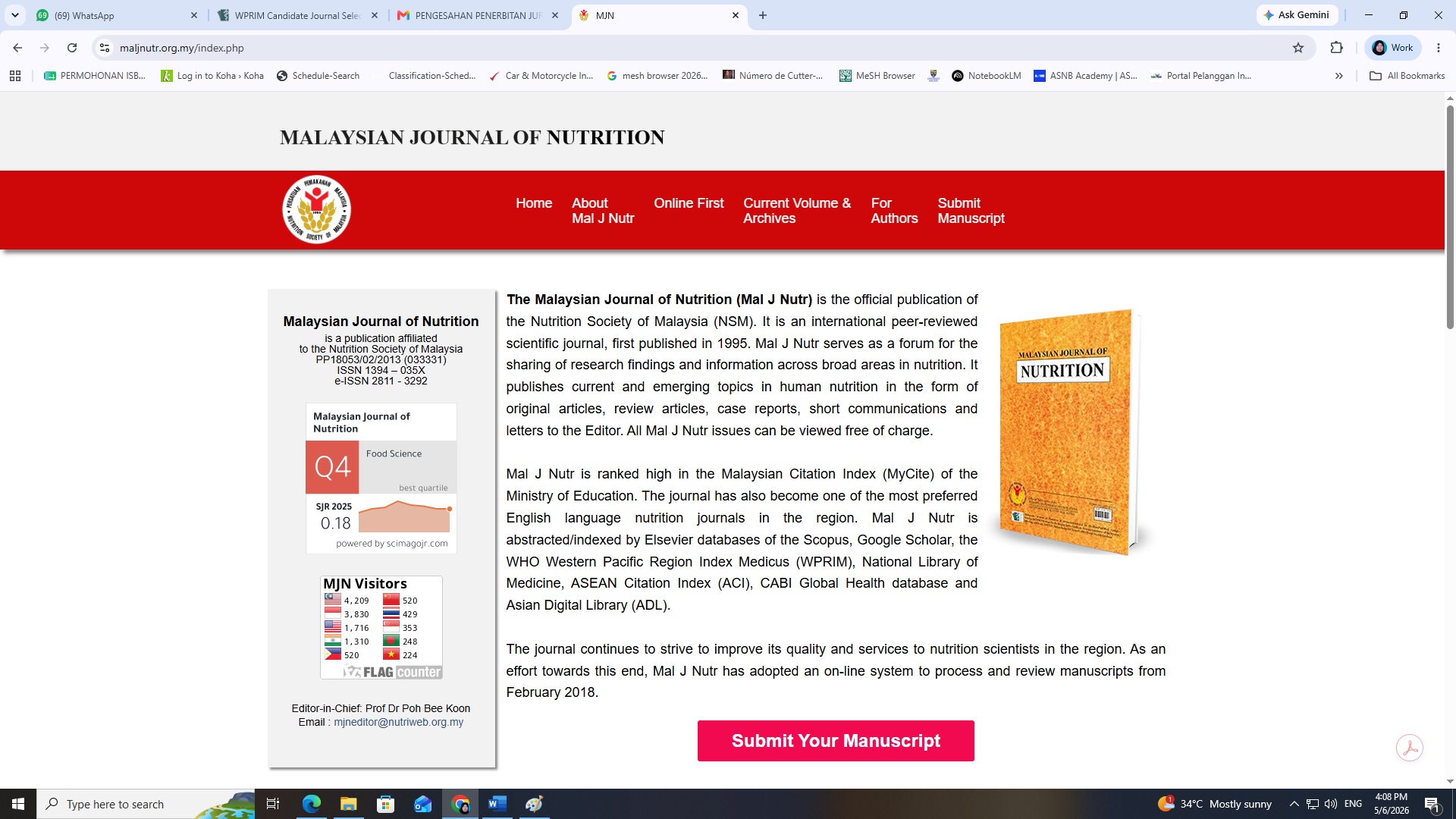
Malaysian Journal of Nutrition is an official publication of the Nutrition Society of Malaysia. It is a refereed scientific journal, publishes three issues a year, presenting original research articles and reviews on all aspects of nutrition. The principal focus includes studies of dietary intake and nutritional status of community, nutrition physiology and biochemistry, practice of dietetics,clinical nutrition, public health nutrition, nutritional quality of foods, bioavailability of nutrients and topics related to human nutrition.

Related Sites

WHO WPRO GIM

Help Accessibility
DCMS Web Policy
CJSS Privacy Policy

Powered by IMICAMS( 备案号: 11010502037788, 京ICP备10218182号-8)

Successfully copied to clipboard.