

Main content 1 Menu 2 Search 3 Footer 4
+A
A
-A
High contrast
HOME JOURNAL CRITERIA NETWORK HELP ABOUT

Current criteria:

Regional:

WPRlM journal selection criteria(2023)

Minimum standards for the suspension and removal of WPRIM approved journals

Countries journal selection criteria:

Philippines

Submit your journal information>

Contact NJSCs>

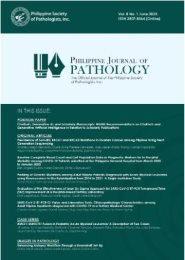
Philippine Journal of Pathology

2002 (v1, n1) to Present ISSN: 1671-8925

Articles

About

Year of publication

Save Email

Sort by

Best match
Relevance
PubYear
JournalTitle

DISPLAY OPTIONS

Format:

Per page:

Save citations to file

Selection:

Format:

Create file Cancel

Email citations

To:

Please check your email address first!

Selection:

Format:

Send email Cancel

87

results

page

of 9

1

Cite

Cite

Copy

Share

Share

Copy

Coagulation and platelet profiles of COVID-19 patients admitted to a COVID Referral Center from March 2020 to December 2022

Ivana Ungajan-Galapon ; Karen Damian ; Nelson Geraldino

Philippine Journal of Pathology.2024;9(1):11-16.

Objective: This study aimed to determine the demographic profiles of admitted COVID-19 patients, the association of coagulation and platelet tests on COVID-19 severity and compare the coagulation and platelet profile across the spectrum of the disease in terms of severity among adult COVID-19 patients admitted to the Philippine General Hospital from March 2020 to December 2022. : Methodology. Medical records of a sample of adult COVID-19 patients admitted to the emergency room of the Philippine General Hospital from March 2020 to December 2022 were reviewed. The demographics, initial COVID-19 diagnosis and initial coagulation and platelet test results were gathered and tabulated. Comparison of the initial coagulation and initial platelet results were made per disease category. Results: Three hundred eighty-five (385) patients were included; 194 were males, and 191 were females. The mean age of all patients was 56.18 years old. There was a total of 30 patients classified as mild and 105 patients are under moderate category. 141 patients were classified as severe, whereas 109 patients were classified as critical. Platelet count test and Activated Partial Thromboplastin Time (APTT) were mostly normal in all disease categories. Prothrombin time was normal in a majority of patients from the mild and severe categories. INR and D-dimer were all elevated mostly in all disease categories. Conclusion Platelet counts and APTT were mostly normal in all disease categories. Prothrombin time and D-dimer had a significant association with disease severity. Platelet count, APTT and INR did not show significant association with disease severity. Prothrombin time, APTT, INR and D-dimer means had significant differences versus disease categories.
Partial Thromboplastin Time ; OVID-19 ; Patient Acuity

Partial Thromboplastin Time ; OVID-19 ; Patient Acuity
2

Cite

Cite

Copy

Share

Share

Copy

Mucinous tubular and spindle cell carcinoma of the kidney: A case report and concise review of literature

Hasmin Lisa Corpuz ; Valerie Anne Tesoro

Philippine Journal of Pathology.2024;9(1):42-45.

Mucinous tubular and spindle cell carcinoma (MTSCC) is a rare neoplasm of the kidney. Recognition of this rare entity is important with regards to a patient’s prognosis and therapeutic management.
Kidney Neoplasms ; Immunohistochemistry ; Pathology, Surgical

Kidney Neoplasms ; Immunohistochemistry ; Pathology, Surgical

3

Cite

Cite

Copy

Share

Share

Copy

Prevalence and clinico-pathologic features of ALK rearrangement among adult Filipinos with non-small cell lung cancer in a Private Tertiary Care Hospital

Steffanie Charlyne Tamayo ; Rebecca Nagtalon ; Joanmarie Balolong-Garcia ; Yancel Donna Mascardo ; Jose Jasper Andal ; Daphne Ang ; Marcelo Severino Imasa ; Rex Michael Santiago

Philippine Journal of Pathology.2022;7(1):9-14. doi:10.21141/PJP.2022.04

Introduction: With advancements in the understanding of lung cancer biology, targeted therapy has become the rule rather than the exception. Patients with ALK rearrangements are amenable to therapy with Alectinib and other ALK inhibitors, which has been associated with better patient outcomes. While ALK rearrangement should be routinely tested in non-squamous non-small cell lung cancer (NSCLC), the cost and availability of this test is a prohibitive factor, particularly in the Philippine setting. Objectives: This study aimed (1) to determine the prevalence of ALK-rearranged NSCLC among adult Filipino lung cancer patients in St. Luke’s Medical Center (SLMC) from 2016 to 2018 and (2) to determine the clinico-pathologic features of adult Filipinos with ALK-rearranged NSCLC. Methodology: This is a retrospective cross-sectional descriptive study wherein the prevalence of ALK-rearranged NSCLC, detected using fluorescence in-situ hybridization (FISH) or immunohistochemistry (IHC), was determined. Clinical data of patients for whom ALK testing was performed were collected. Hematoxylin and Eosin (H&E) slides were retrieved and reviewed for the presence of certain morphologic features. Patients whose H&E slides cannot be retrieved were excluded from the study. Results: ALK rearrangement was seen in 7.8% (8/103) of tumors submitted for ALK testing. Patients with ALK-rearranged tumors were generally young, light smokers, and presented with advanced clinical stage. Clear cell features and solid pattern were noted in one case and three cases, respectively. However, due to small sample size, further statistical analysis could not be performed to analyze the association of these features with the presence of ALK rearrangement. Conclusion Despite a small sample size, the prevalence and clinical profile of ALK-rearranged NSCLC in our institution are congruent with those previously described in Western populations. The association of clinical profile and morphologic features with the presence of ALK rearrangement can be further explored in future studies.
Lung Neoplasms ; Anaplastic Lymphoma Kinase

Lung Neoplasms ; Anaplastic Lymphoma Kinase

4

Cite

Cite

Copy

Share

Share

Copy

Application of the Milan System of reporting salivary gland cytopathology: A retrospective cytohistological study in a Tertiary Medical Center

Carolyn Marie Legaspi ; Elizabeth Ann Alcazaren ; Jose Carnate Jr.

Philippine Journal of Pathology.2022;7(1):15-23. doi:10.21141/PJP.2022.03

Background: A fine needle aspiration biopsy has been established as a safe, minimally invasive procedure in evaluation of salivary gland lesions. The complex overlapping cytomorphology of these lesions are challenging for pathologists, hence the introduction of an evidence-based system, the Milan System of Reporting Salivary Gland Cytopathology, to improve overall patient care. The study was taken up to reclassify salivary gland lesions from previous FNA biopsies in order to determine sensitivity, specificity, positive and negative predictive values of FNA, and evaluate the risk of malignancy of the various categories of the Milan system. Methodology: This was a 6-year retrospective descriptive study in a tertiary medical center. All salivary gland FNA cases were reviewed by two pathologists, and re-classified into the six categories of the Milan System. The number of false positive, false negative, true positive and true negative cases were obtained by comparing with the final histopathology diagnosis, and the risk of malignancy per category were calculated. Results: A total of 76 cases were reviewed and the overall average of the two readers diagnostic accuracy were 85.02% (95% CI: 84.50-85.60%), sensitivity and specificity were 80.77% (95% CI: 79.90-81.60%) and 86.19% (95% CI: 85.70-86.70%), respectively; positive and negative predictive values were 62.16% (95% CI: 60.70-63.60%) and 94.17% (95% CI: 94.00-94.40%), respectively. Conclusion The Milan System category with highest risk of malignancy was Malignant (Category VI – 100%). FNAB is still a reliable tool for clinicians, and use of the Milan System of Reporting Salivary Gland Cytopathology is beneficial in increasing efficacy of communication among clinicians to improve patient care.
Cytology ; Salivary Glands

Cytology ; Salivary Glands

5

Cite

Cite

Copy

Share

Share

Copy

Preliminary study on prevalence of P16-Positive Squamous Cell Carcinoma of the oral cavity, oropharynx and larynx in Rizal Medical Center and its histomorphologic correlation

Jorel Renly Gamboa ; Thomas Jeff Lim Jr.

Philippine Journal of Pathology.2022;7(1):24-30. doi:10.21141/PJP.2022.08

Background: A considerably large portion of the cases of cancer, particularly squamous cell carcinoma (SCC) involving the head and the neck may be due to consumption of tobacco and alcohol. However, its increase in occurrence at specific sites of the head and neck may indicate the possibility of other etiological factors. One of which is infection by certain high-risk human papillomavirus (HPV). P16 immunochemistry serves as a very good surrogate marker of active HPV in these tumors. The detection of HPV-related head and neck cancers have relevance in clinical practice because of its prognostic implications. Objectives: The general objective of this study is to determine the prevalence of p16-positive squamous cell carcinoma in the oral cavity, oropharynx, and larynx in Rizal Medical Center from January 2019 to December 2019. The specific objective is to compare the Hematoxylin and Eosin (H&E) stain histomorphology (keratinization and mitotic activity) of p16-positive versus p16-negative specimens. Methodology: This is a cross-sectional study which included all routine histopathology specimens coming from the oral cavity, oropharynx and larynx in Rizal Medical Center for the year 2019 with a diagnosis of squamous cell carcinoma. The tissue specimens considered were those that measured at least 1 cm in diameter, or aggregate diameter if tissue is fragmented. The slides of all eligible cases were reviewed and immunohistochemically stained for p16. The p16 IHC slides were read as either positive or negative, while the mitotic activity and keratinization were observed in the H&E-stained slides. The interpretation of the diplomate pathologists for each of the slides were documented and corresponding statistical analyses were performed. Results: P16 IHC showed twenty-one (88%) p16 negative cases and three (12%) p16 positive cases. In terms of mitosis, ten cases have mitosis falling within the 1-10 per high power field (HPF) range (42%), six within 11-20 per HPF (25%), and 8 cases have ≥21 mitosis per HPF (33%). In terms of keratinization, three cases are non-keratinizing (12%) and twenty-one cases are keratinizing (88%). There is significant difference in the keratinization histology (p<0.05) of the p16-positive versus the P16-negative cases. On the other hand, no significant difference in the mitotic activity (p>0.05) was noted. Conclusion There is a low prevalence of HPV-related SCC of the oral cavity, oropharynx, and larynx in Rizal Medical Center. The histomorphologic findings confirm that keratinization, significantly predicts HPV status in oropharyngeal SCC. Mitotic activity may not be reliable in predicting the HPV status or p16 IHC reactivity of a case. Keratinization in oropharyngeal SCCs may provide valuable information in certain instances, particularly when HPV testing is not immediately available, although the combined tumor morphology and p16 IHC is more ideal.
Papillomavirus Infections ; Squamous Cell Carcinoma of Head and Neck ; Mouth ; Larynx

Papillomavirus Infections ; Squamous Cell Carcinoma of Head and Neck ; Mouth ; Larynx

6

Cite

Cite

Copy

Share

Share

Copy

Determination of rates of malignancy on archival salivary gland fine-needle aspiration biopsy after application of the Milan System for Reporting Salivary Gland Cytopathology in the Philippine General Hospital: A 1-year retrospective study

Nikko Paolo Cablao ; Pauleen de Grano ; Agustina Abelardo ; Jose Ma. Avila ; Dahlia Teresa Argamosa

Philippine Journal of Pathology.2022;7(1):31-37. doi:10.21141/PJP.2022.09

Background: The Milan System for Reporting Salivary Gland Cytopathology (MSRGC) aims to increase the overall effectiveness of salivary gland FNAB by defining six general diagnostic categories with corresponding Rates of Malignancies (ROM). This study aims to use this system to categorize salivary gland FNAB in the Philippine General Hospital and stratify ROM per category. Methodology: In this study a total of 326 cases have been collected and reviewed, of which 154 (47.2%) had either surgical or clinical follow-up. The cases were assigned a Milan category by 3 cytopathologists blinded from the original diagnoses and from each other’s readings. Results: The overall sensitivity, specificity, PPV, and NPV in detecting neoplasm is at 71.6%, 90.9%, 88.3%, and 76.9%, respectively. On the other hand, the sensitivity, specificity, PPV, and NPV in detecting malignancy is at 52%, 92.9%, 59.1%, and 90.7%, respectively. The computed ROM is as follows: Category I 7.89%, Category II 9.43%, Category III 20%, Category IVa 10.53%, Category IVb 60%, Category V 75%, and Category VI 100%. Conclusion The overall diagnostic utility of salivary gland FNAB, as well as the computed ROM per diagnostic category are comparable to internationally published literature. This study also validates the MSRSGC as a valuable tool in stratifying ROM in salivary gland lesions.
Cytology ; Salivary Glands

Cytology ; Salivary Glands

7

Cite

Cite

Copy

Share

Share

Copy

The utility of immunohistochemistry in diagnosing tubulocystic renal cell carcinoma with papillary morphology

Allison Kaye Pagarigan ; Erland del Rosario

Philippine Journal of Pathology.2022;7(1):39-45. doi:10.21141/PJP.2022.02

Tubulocystic renal cell carcinoma (TC-RCC) is a recently recognized, rare but distinct malignant entity. Pathologists have endeavored to completely define its histomorphologic, immunohistochemical and molecular features. Recounted is a case where the diagnosis of TC-RCC was confounded by presence of papillary morphology. Immunohistochemical expression of alpha-methyl acyl-CoA-racemase and vimentin with corresponding negativity for CK7 and CD10, following distinctive gross and microscopic findings, confirmed a diagnosis of TC-RCC. This report demonstrates the strategic value of performing immunohistochemistry studies to establish a diagnosis of TC-RCC especially when unusual histologic features are encountered. Immunohistochemistry continues to be the most practical approach to diagnosis as molecular testing methods, such as next generation sequencing, remain unfeasible in the local setting. Cautious prognostication is required as accounts of recurrence and metastasis continue to emerge.
Carcinoma, Renal Cell ; Histology ; Immunohistochemistry ; Diagnosis ; Pathology, Surgical

Carcinoma, Renal Cell ; Histology ; Immunohistochemistry ; Diagnosis ; Pathology, Surgical

8

Cite

Cite

Copy

Share

Share

Copy

Glomangiopericytoma: A rare sinonasal neoplasm

Karen Damian ; Rachel Alegata

Philippine Journal of Pathology.2022;7(1):46-49. doi:10.21141/PJP.2022.06

Glomangiopericytoma is a rare neoplasm of the nasal and paranasal sinuses comprising less than 1% of all tumors of the said region. We report of a 59-year-old hypertensive male who presented with epistaxis. CT scan findings showed a mass in the right nasal cavity with extension into the ethmoid and sphenoid sinuses. Histopathologic diagnosis was glomangiopericytoma confirmed with immunohistochemistry studies. Prognosis is favorable with complete resection of tumor and long-term monitoring.
Paranasal Sinus Neoplasms

Paranasal Sinus Neoplasms

9

Cite

Cite

Copy

Share

Share

Copy

Brain metastasis of papillary ovarian adenocarcinoma

Sonia Chhabra ; Niti Dalal ; Sunita Singh

Philippine Journal of Pathology.2022;7(1):50-52. doi:https://philippinejournalofpathology.org/index.php/PJP/article/view/277/437

Brain metastasis from epithelial ovarian cancer is a rare diagnostic entity with a reported incidence of 1- 2%. Serous epithelial ovarian cancer is usually associated with a poor prognosis and is the most common malignancy metastasizing to the brain. The median time from primary diagnosis to development of cerebral lesions is directly correlated with the initial tumour grade and stage. The median survival after diagnosis of brain metastases is 6 months. It is suggested that brain imaging studies should be included in the follow up of patients after treatment for ovarian carcinoma. We report a case of brain metastasis of ovarian adenocarcinoma 2 years post-surgery and six cycles of chemotherapy.
Brain ; Neoplasm Metastasis ; Adenocarcinoma

Brain ; Neoplasm Metastasis ; Adenocarcinoma

10

Cite

Cite

Copy

Share

Share

Copy

Ectopic schistosomiasis presenting as ruptured appendicitis with periappendiceal abscess formation: An alternative pathogenetic perspective

Marcel Joshua del Fierro ; Yvette Tan ; Larissa Lara Torno

Philippine Journal of Pathology.2022;7(1):53-56. doi:https://philippinejournalofpathology.org/index.php/PJP/article/view/303/443

Schistosomiasis is still a public health burden in the Philippines. Chronic infection with Schistosoma japonicum, the only species endemic in the Philippines, clinically manifests itself in a wide variety of pathologies usually correlated with the anatomical site of adult worm activity and deposition of eggs. One of the documented ectopic sites for Schistosoma ova is the appendix. A rare sequela of this is acute appendicitis and an even rarer consequence is progression to appendiceal rupture leading to acute peritonitis. We present a case of a 27-year-old Filipino residing in Davao City but born in Agusan Province who initially complained of right lower quadrant abdominal pain but presented at the emergency room with generalized abdominal tenderness with signs of peritoneal irritation. Exploratory laparotomy with an infraumbilical incision revealed ruptured appendicitis with periappendiceal abscess formation and appendectomy was subsequently done. Schistosoma infection of the appendix was subsequently established by histopathological analysis. Furthermore, features observed suggest an atypical pathogenetic process contrary to the putative pathogenesis of most cases of acute appendicitis.
Schistosomiasis ; Schistosoma japonicum

Schistosomiasis ; Schistosoma japonicum

Country

Philippines

Publisher

Philippine Society of Pathologists, Inc.

ElectronicLinks

http://philippinejournalofpathology.org

Editor-in-chief

Amado O. Tandoc III, MD, DPSP

E-mail

philippinepathologyjournal@gmail.com

Abbreviation

PJP

Vernacular Journal Title

ISSN

2507-8364

EISSN

2507-8364

Year Approved

2023

Current Indexing Status

Currently Indexed

Start Year

2016

Description

The Philippine Journal of Pathology (PJP) is an open-access, peer-reviewed, English language, medical and health science journal that is published continuously online and semi-annually in print by the Philippine Society of Pathologists, Inc. (PSP, Inc). All manuscripts must be submitted through the PJP Official Website (Open Journal Systems) (http://philippinejournalofpathology.org). All other correspondences and other editorial matters should be sent via electronic mail to philippinepathologyjournal@gmail.com. Articles and any other material published in the PJP represent the work of the author(s) and do not reflect the opinions of the Editors or the Publisher. Articles that do not subscribe to the Instructions to Authors shall be promptly returned.

Related Sites

WHO WPRO GIM

Help Accessibility
DCMS Web Policy
CJSS Privacy Policy

Powered by IMICAMS( 备案号: 11010502037788, 京ICP备10218182号-8)

Successfully copied to clipboard.