

Main content 1 Menu 2 Search 3 Footer 4
+A
A
-A
High contrast
HOME JOURNAL CRITERIA NETWORK HELP ABOUT

Current criteria:

Regional:

WPRlM journal selection criteria(2023)

Minimum standards for the suspension and removal of WPRIM approved journals

Countries journal selection criteria:

Philippines

Submit your journal information>

Contact NJSCs>

Neurology Asia

2002 (v1, n1) to Present ISSN: 1671-8925

Articles

About

Year of publication

Save Email

Sort by

Best match
Relevance
PubYear
JournalTitle

DISPLAY OPTIONS

Format:

Per page:

Save citations to file

Selection:

Format:

Create file Cancel

Email citations

To:

Please check your email address first!

Selection:

Format:

Send email Cancel

835

results

page

of 84

1

Cite

Cite

Copy

Share

Share

Copy

Predictors of medical complications in stroke patients confined in hospitals with rehabilitation facilities: A Filipino audit of practice

Consuelo B Gonzalez-Suarez ; Consuelo B Gonzalez-Suarez ; Karen Grimmer ; Jan-Tyrone C Cabrera ; Isaias P Alipio ; Elda Grace G Anota-Canencia ; Maria Luisa P Santos-Carpio ; Janine Margarita R Dizon ; Lauren Liao ; Romil Martinez ; Eulalia J Beredo ; Carolina M Valdecaňas ; Vania Yu

Neurology Asia.2018;23(3):199-208.

Most medical complications following acute stroke are preventable (such as cardiac events, pneumonia, bed sores and venous thrombosis). This was a study on the frequency of medical complications and their association with key performance indicators. Methods: The study used a cross-sectional baseline audit of stroke care practices. The audit captured details on the nature of the stroke, patient demographics, characteristics of hospital care, and compliance with six key quality indicators in Philippine Academy of Rehabilitation Medicine Clinical Practice Guideline on Stroke Rehabilitation. Patient records were retrospectively consecutively sampled. Results: A total of 1,683 patients were included in the audit which came from 49 hospitals. Medical complications were seen in 182 patients (11.2%). Pneumonia contributed to half the medical complications (50%), followed by respiratory failure (7.7%) and gastrointestinal bleeding (3.8%). Presence of medical complications were associated with in-patient mortality (OR 3.3 (95% CI 2.1-5.3)) and prolonged hospital stay (16.1 ± 20.7 days vs 9.6 + 10.9 days). The best predictor model for pneumonia included variables of not having a swallow screen within the first 24 hours, having a nasogastric tube inserted, not achieving medical stability, not having a stroke unit in the admitting hospital, having suffered a previous stroke and being older. Conclusion: Non-adherence to evidence-based stroke care rehabilitation guidelines contributed significantly to medical complications in an audit of Filipino stroke patients
2

Cite

Cite

Copy

Share

Share

Copy

Carotid intraplaque hemorrhage in patients with greater than fifty percent carotid stenosis was associated an acute focal cerebral infarction

Sangheon Kim ; Hyo Sung Kwak ; Gyung Ho Chung

Neurology Asia.2018;23(3):209-216.

The purpose of this study was to assess associations between acute focal cerebral infarction of anterior circulation and carotid intraplaque hemorrhage (IPH) on magnetization-prepared rapid acquisition with gradient-echo (MPRAGE) in patients with acute neurologic symptoms. Methods: From January 2013 to August 2017, 397 patients (median age, 76 years; male, 78.6%) with acute focal cerebral infarction on diffusion weighted imaging (DWI) were evaluated to determine the maximal wall thickness of the carotid artery, and to look for IPH on carotid MPRAGE sequences. Carotid plaques were defined as carotid artery wall thickness greater than 2 mm in at least two consecutive slices. IPH was defined as the presence in a carotid plaque of MPRAGE signal intensity greater than 200% of the intensity of adjacent muscle. Results: Of these patients with focal cerebral infarction, 165 patients of 195 carotid plaques were included this study. Sixty one (31/3%) carotid plaques of 50 (30.3%) patients were detected MPRAGE positive IPH. Maximal carotid wall thickness and degree of carotid stenosis were significantly higher in the MPRAGE positive group. MPRAGE positive IPH in patients with greater than 50% carotid stenosis was associated with an increased risk of an acute stroke event (p < 0.001), and a 2.64-fold increase in the relative risk of an acute focal stroke, compared to patients with MPRAGE negative scans. Conclusions: Carotid MPRAGE positive IPH in patients with greater than 50% carotid stenosis was associated with acute focal cerebral infarction. MPRAGE positive patients showed higher maximal carotid wall thickness and a higher percentage of carotid stenosis.

3

Cite

Cite

Copy

Share

Share

Copy

Frenkel’s exercise on lower limb sensation and balance in subacute ischemic stroke patients with impaired proprioception

Eun Jae Ko ; Min Ho Chun ; Dae-Yul Kim ; Yujeong Kang ; Sook Joung Lee ; Jin Hwa Y ; Min Cheol Chang ; So Young Lee

Neurology Asia.2018;23(3):217-224.

Few reliable studies have used standardized outcome measures to examine the effectiveness of sensory interventions to treat somatosensory impairment. The aim of this study is to examine the effectiveness of Frenkel’s exercise for improving lower limb sensation, balance, motor function, functional ambulation, and activities of daily living in subacute ischemic stroke patients with impaired proprioception. Methods: This retrospective cohort study enrolled 14 patients suffering subacute ischemic stroke between 7 to 30 days of onset who showed reduced proprioception in the lower limbs. They were divided into two groups: intervention group (performed Frenkel’s exercise, 15 minutes per day, 15 days over a period of 3 weeks, n=7) and control group (received conventional physical therapy instead, n=7). Outcome measurements included the kinesthetic and light touch sensation subscales of the Nottingham Sensory Assessment (NSA) for the lower limb, the Korean version of the Berg balance scale (K-BBS), the Functional Ambulation Classification (FAC), the Motricity Index (MI), and the Korean version of the Modified Barthel Index (K-MBI). Results: Patients in both groups showed significant improvements on the kinesthetic and tactile sensation subscale of the NSA for the lower limb, the K-BBS, the FAC, and the K-MBI, but not the MI, from baseline to post-intervention at 3 weeks. When compared between the two groups, significant improvements were only seen in the kinesthetic sensation subscale of the NSA for the lower limb and the K-BBS (p<0.05). Conclusions: Frenkel’s exercise improves sensory and balance recovery among subacute ischemic stroke patients with impaired proprioception and minimal lower limb motor weakness.

4

Cite

Cite

Copy

Share

Share

Copy

A validation study of the Bahasa Malaysia version of the National Institute of Health Stroke Scale

Najma Kori ; Wan Asyraf Wan Zaidi ; Rabani Remli ; Azman Ali Raymond ; Norlinah Mohamed Ibrahim ; Hui Jan Tan ; Syed Zulkifli Syed Zakaria ; Zhe Kang Law ; Kartini Ahmad ; Wan Nafisah Wan Yahya ; Ramesh Sahathevan

Neurology Asia.2018;23(3):225-232.

Background & Objectives: The National Institute of Health Stroke Scale (NIHSS) provides a valid and quick assessment of stroke severity in hyperacute stroke management. Stroke patients who are eligible for reperfusion therapy require prompt assessment. There is no validated Bahasa Malaysia (BM) version of the NIHSS that allows easier assessment by BM-speaking health professionals. This study aimed to translate and validate a BM version of the NIHSS. Methods: The English NIHSS was translated to BM, then back translated to ensure linguistic accuracy. We also adapted the language assessment of the NIHSS to be more culturally appropriate. Training and certification videos were downloaded from the NIH website and dubbed into BM. We determined intra-class correlation and unweighted kappa as the best measure of reliability. Median scores were used in the analysis for language items. Results: One hundred and one raters participated in the test-retest reliability study. Agreement between the original NIHSS and our translated version of the BM-NIHSS was good (ICC = 0.738, 95% CI: 0.611 to 0.823). Fair to moderate agreement was found on item-by-item analysis (unweighted κ=0.20-0.50) despite high observed agreement. Fifty patients participated in the language assessment arm. Scores were better in BM for reading, naming objects and repetition (Mdn = 100, p < 0.001). There was no difference in the median scores for the description component. Conclusions: The BM-NIHSS is a valid translation of the NIHSS, and may be used in clinical practice by BM-speaking healthcare professionals.

5

Cite

Cite

Copy

Share

Share

Copy

Extracorporeal shock wave therapy in cubital tunnel syndrome: A pilot study

Yu-Ping Shen ; Yin-Yin Wu ; Heng-Yi Chu ; Tsung-Ying Li ; Liang-Cheng Chen ; Yung-Tsan Wu

Neurology Asia.2018;23(3):233-238.

To investigate the clinical therapeutic effect of extracorporeal shock wave therapy in the treatment of cubital tunnel syndrome. Methods: Seven patients (10 elbows) with moderate cubital tunnel syndrome participated in this study. Three sessions of radial extracorporeal shock wave therapy (2,000 shots, 4 Bar, 5 Hz) (once a week) were administered to the ulnar nerve at the proximal cubital tunnel region. The primary and secondary outcomes were assessed using the Visual Analog Scale (VAS) and the shortened Disabilities of the Arm, Shoulder and Hand questionnaire (Quick DASH), respectively, at the 4th, 8th, and 12th week, following the 3rd session of shock wave therapy. Results: The VAS and Quick DASH scores demonstrated improvements at all follow-up time points, in all treated elbows. The mean VAS and Quick DASH score improved from 4.7±0.3(mean±SE) to2.2±0.2 and 16.6±2.1to 6.8±1.6 respectively during 12 weeks follow up (all p <0.01). Conclusion: This pilot study revealed the safety and efficacy of extracorporeal shock wave therapy in patients with moderate cubital tunnel syndrome.

6

Cite

Cite

Copy

Share

Share

Copy

Neuroanatomical correlates of depressive symptoms in newly diagnosed Parkinson’s disease patients

Seong-il Oh

Neurology Asia.2018;23(3):239-244.

Objective: Depression is the most frequent neuropsychiatric manifestation in Parkinson’s disease (PD). Although evidence suggests that depression in PD is related to the degenerative process that underlies the disease, a complete understanding of neural substrates has yet to be achieved. To investigate the neuroanatomical changes underlying depression in PD, we conducted a surface-based morphometry (SBM) study in de novo, drug-naïve Parkinson’s disease patients with and without depression. Methods: We studied thirty-one patients with idiopathic, de novo, drug-naïve PD. Patient clinical characteristics, including age, sex, disease duration, Hoehn and Yahr stage, UPDRS part III, and brief neuropsychological testing, were assessed. Sixteen Parkinson’s disease patients with depression (PD-D) were defined as patients with abnormal geriatric depressions scales (> 17 points), and fifteen patients had Parkinson’s disease without depression (PD-ND). The SBM analysis of cortical thickness was performed to determine the difference between the PD-D and PD-ND groups. Results: There were no differences in terms of clinical characteristics between the PD-D and PD-ND groups, but the level of education in the PD-ND was higher than that in the PD-D. The cortical thickness was significantly decreased in the left anterior cingulate and left precentral gyrus in the PD-D group compared to the PD-ND group. Conclusion: Depression in Parkinson’s disease is associated with the left anterior cingulate and left precentral gyrus region reduced cortical thickness

7

Cite

Cite

Copy

Share

Share

Copy

Cervical dystonia in Parkinson’s disease: Retrospective study of later-stage clinical features

Hiroshi Kida ; Shiroh Miura ; Yoshihiro Yamanishi ; Tomoyuki Takahashi ; Takashi Kamada ; Akiko Yorita ; Mitsuyoshi Ayabe ; Hideki Kida ; Tomoaki Hoshino ; Takayuki Taniwaki

Neurology Asia.2018;23(3):245-251.

Objective: Cervical dystonia (CD) is a clinically under-recognized symptom occurring at the later- to end-stages of Parkinson’s disease (PD). The frequency of CD and its influence on prognosis have not been well studied. Here, we conducted an in-depth examination of CD incidence and impact on disease progression in later-stage PD. Methods: We retrospectively reviewed the clinical features of 22 deceased patients with sporadic PD treated at a hospital in Japan from 1983 to 2008. Results: The most common cause of death in PD was pneumonia. CD, in particular retrocollis, was frequent in the later stages of the disease in elderly patients (9/22, 40.9%). Pneumonia incidence increased sharply in the later period with CD. There was a positive trend between CD duration and duration of pergolide use. Conclusion: Analysis revealed that CD increases markedly in late- to end-stage PD, which may be associated with aspiration pneumonia due to dysphagia. Pathological mechanisms underlying CD might be influenced by treatments including dopamine agonists. Prevention of CD may increase quality of life and prolong survival of PD patients.

8

Cite

Cite

Copy

Share

Share

Copy

Evaluation of cognitive functions in patients with obstructive sleep apnea before and after continuous positive airway pressure treatment

Yagmur İnalkac Gemici ; Levent Ozturk ; Canan Celebi

Neurology Asia.2018;23(3):253-258.

Objectives: The aim of this study is to evaluate the remedial effect of continuous positive airway pressure (CPAP) therapy on neurocognitive function in obstructive sleep apnoea (OSA) patients. Methods: The cognitive impairment in OSA patients was evaluated with Montreal Cognitive Assessments (MoCA) before and after CPAP therapy. The study assessed 54 patients who were diagnosed with OSAS seen at the neurology clinic of the Trakya University Medical Faculty. They were given MoCA the day of diagnosis, after one day of CPAP therapy, and after three months of CPAP therapy. Results: MoCA scores before treatment showed a statistically significant correlation between disease severity and abstract thinking (Correlation coefficient: 0.270±0.048). There was no significant difference between MoCA scores before treatment and after one day of CPAP therapy (p=0.244). However, there were significant improvements in MoCA scores after three months of treatment, when compared to scores from before treatment and after one day of therapy (p<0.001). Conclusions: CPAP treatment may improve cognitive function in OSA patients. MoCA is an effective and simple tool for evaluating cognitive function.

9

Cite

Cite

Copy

Share

Share

Copy

Departmant of Neurology Sırnak State Hospital, Şırnak, Turkey

Sang Hun Lee ; Sun Ju Lee ; Il Eok Jung ; Jin-Man Jung

Neurology Asia.2018;23(3):259-262.

Isolated middle cerebral artery (MCA) dissection with atherosclerosis is a rare entity, and its clinical progression is not well known. We recently came across a case of isolated MCA dissection with atherosclerosis. A 62-year-old man presented to the emergency department with right-sided weakness and mild aphasia. Diffusion-weighted imaging (DWI) showed a multifocal infarction in the left MCA region, and perfusion Magnetic resonance imaging (MRI) detected a moderate time delay in the left MCA region. High-resolution MRI and transfemoral cerebral angiography revealed that the atherosclerotic plaque was accompanied by the dissecting intimal flap. Despite 40 days of antiplatelet therapy, the ischemic stroke recurred and the dissection did not heal. After stenting, the MCA and intracranial circulation revealed a widened lumen and improved flow across the dissection, and no embolic sequelae in the distal intracranial circulation. This case suggest that in MCA dissection with atherosclerosis, early stage intracranial stenting may be a better therapeutic strategy than medical treatment, to prevent recurrent cerebral infarction

10

Cite

Cite

Copy

Share

Share

Copy

Hemi masticatory spasm with facial hemi atrophy and localized scleroderma: Report of a case with bilateral involvement

Divya M Radhakrishnan ; Garima Shukla ; Vinay Goyal

Neurology Asia.2018;23(3):263-266.

We report a rare case of a 45 year old female with 15 year history of progressive left facial thinning with frequent episodes of involuntary jaw closure and almost continuous rippling movements over her left sided masticatory muscles. There was localized scleroderma, left facial hemi atrophy and left hemi masticatory spasm. Localized scleroderma was proven histopathologically. Electrophysiological studies revealed normal blink reflex on both sides. Her masseter inhibitory reflex was absent bilaterally and surface electromyogram showed spontaneous bursts of high frequency activity over bilateral masseter and left temporalis muscles. The patient responded remarkably with bilateral botulinum toxin injection. This case highlights presence of rare bilateral involvement of HMS especially on EMG and excellent response to botulinum toxin.

Country

Malaysia

Publisher

ASEAN Neurological Association and the Asian & Oceanian Association of Neurology

ElectronicLinks

http://www.neurology-asia.org/

Editor-in-chief

Professor Chong Tin Tan

E-mail

editor@neurology-asia.org

Abbreviation

Neurol Asia

Vernacular Journal Title

ISSN

1823-6138

EISSN

Year Approved

Current Indexing Status

Currently Indexed

Start Year

Since 1996

Description

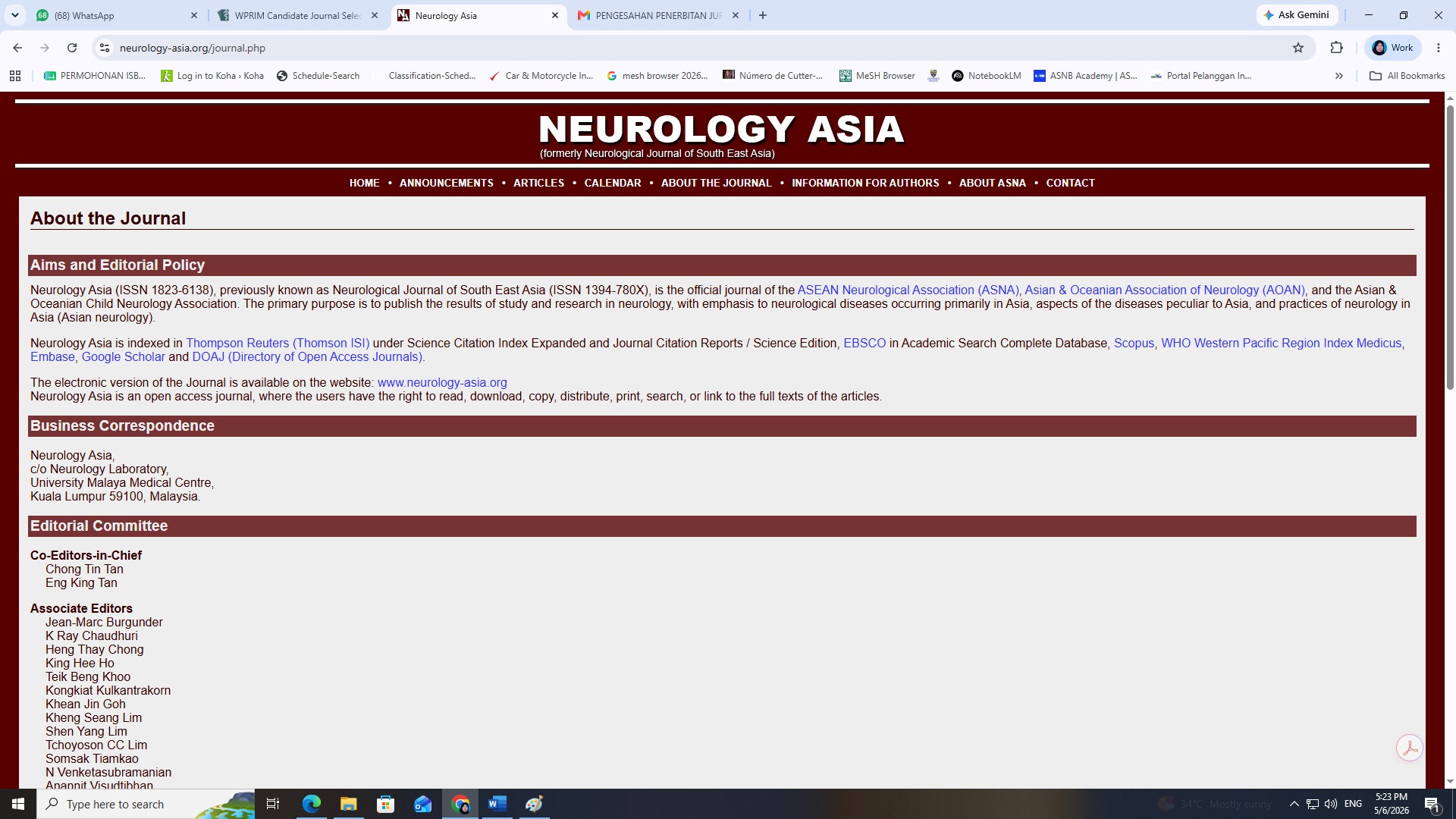
Neurology Asia, previously known as Neurological Journal of South East Asia, is also participated by other national neurological associations in Asia, and the regional neurological associations: Asian & Oceanian Myology Centre, Asian Epilepsy Academy of the International League Against Epilepsy, and Multiple Sclerosis Asia Pacific Study Group. The primary purpose is to publish the results of study and research in neurology, especially Asian neurology, the medical sciences applied to neurological diseases occurring primarily in Asia, and aspects of diseases peculiar to Asia.

Related Sites

WHO WPRO GIM

Help Accessibility
DCMS Web Policy
CJSS Privacy Policy

Powered by IMICAMS( 备案号: 11010502037788, 京ICP备10218182号-8)

Successfully copied to clipboard.