Main content 1 Menu 2 Search 3 Footer 4
+A
A
-A
High contrast
HOME JOURNAL JOURNAL SELECTION NETWORK HELP ABOUT

Journal Selection Criteria and Standards

WPRIM Journal Selection Criteria (August 2023)

NJSC Philippines Selection Criteria (for Philippine-based journals only)

Minimum standards for the suspension and removal of WPRIM approved journals

Application and Indexing Process

Application and Submission Process for WPRIM Indexing

Journal Content Management

Candidate Journal Selection and Data Creation and Management System

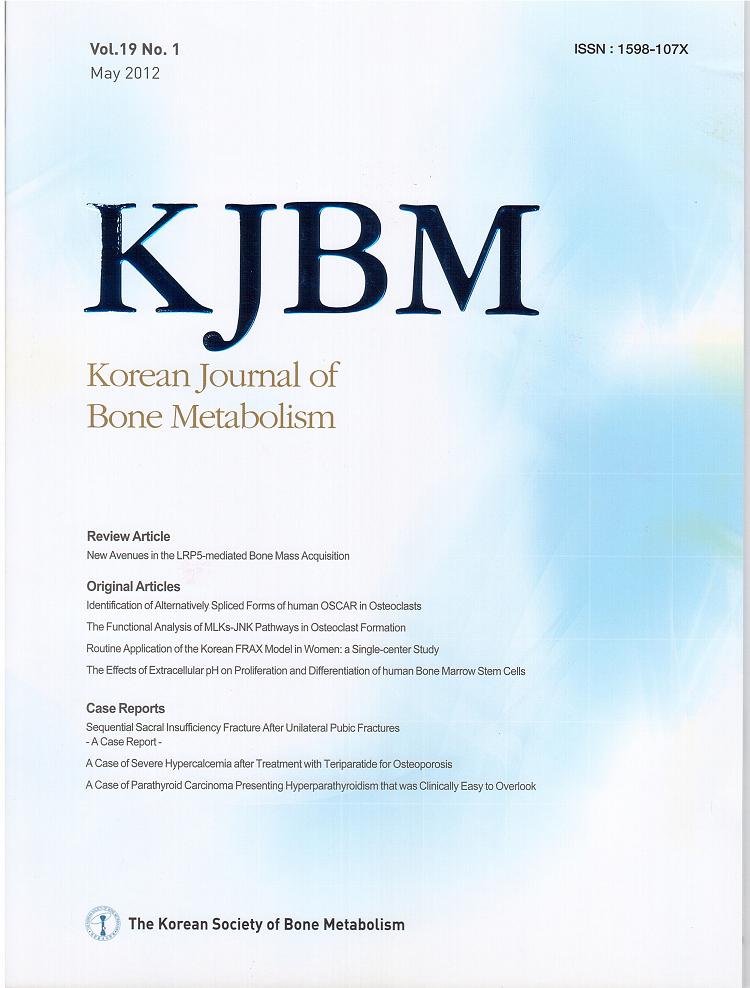
Korean Journal of Bone Metabolism

  to  Present  ISSN: 1598-107X

Articles

About

Save Email

Sort by

Best match
Relevance
PubYear
JournalTitle

DISPLAY OPTIONS

Format:

Per page:

Save citations to file

Selection:

Format:

Create file Cancel

Email citations

To:

Please check your email address first!

Selection:

Format:

Send email Cancel

33

results

page

of 4

1

Cite

Cite

Copy

Share

Share

Copy

Sequential Bilateral Insufficiency Fractures of the Femur Neck in Patients Treated with Prolonged Bisphosphonate Therapy: A Case Report.

Chung Hee OH ; Kyung Won CHOI ; Ji Hoon BAEK ; Yong Chan HA ; Soo Yong KANG

Korean Journal of Bone Metabolism.2011;18(1):65-68.

The relationship between long-term bisphosphonate usage and insufficiency fracture in osteoporotic elderly patients has been increased interest in recent years. Most reported insufficiency fractures are predominantly concentrated on proximal femoral shaft or pelvic bone. However, there was no report about insufficiency femoral neck fracture after long term use of bisphosphonate in domestic. We experienced a rare case of a 70-years-old woman who was diagnosed with bilateral insufficiency femoral neck fracture after 8 years use of alendronate. We performed an internal fixation using 6.5 mm diameter cannulated screws for the both insufficiency femoral neck fracture. Symptoms disappeared immediately after the surgery and there was no radiologic and clinical complication such as nonunion or delayed union up to the latest follow-up at 12 months postoperatively.
Aged ; Alendronate ; Female ; Femoral Neck Fractures ; Femur ; Femur Neck ; Follow-Up Studies ; Fractures, Stress ; Humans ; Pelvic Bones

Aged ; Alendronate ; Female ; Femoral Neck Fractures ; Femur ; Femur Neck ; Follow-Up Studies ; Fractures, Stress ; Humans ; Pelvic Bones

2

Cite

Cite

Copy

Share

Share

Copy

The Association between Components of the Metabolic Syndrome and Bone Mineral Density.

Jin Sung YUK ; Geum Joon CHO ; Chan Hee JIN ; Kyong Wook YI ; Tak KIM ; Jun Young HUR ; Sun Haeng KIM ; Jung Ho SHIN

Korean Journal of Bone Metabolism.2011;18(1):55-64.

OBJECTIVE: The aim of this study was to evaluate the association between the components of the metabolic syndrome (MS) and bone mineral density (BMD). METHODS: We conducted a retrospective cross-sectional analysis for 128 men (mean age 50.4 +/- 8.3 years) and 391 women (mean age 46.9 +/- 11.6 years) in Korea University Guro Hospital, Korea. Height (cm), weight (kg), waist circumference (cm), and blood pressure (mmHg) were measured. Fasting plasma glucose (FPG), high-density lipoprotein cholesterol (HDL-C), and triglycerides were measured. BMD at the total hip and lumbar spine was measured by dual X-ray densitometry. All participants completed a standardized questionnaire including medical history, smoking history, alcohol consumption, physical activity and menopausal status. RESULTS: Women with MS had lower BMD at lumbar and total hip sites (0.937 +/- 0.136 g/cm2, P-value 0.010; 0.875 +/- 0.113 g/cm2, P-value 0.045, respectively) than did women without MS. These differences at the spine and femoral neck were persisted after adjusting for age, body mass index, menopause status, alcohol consumption, smoking and physical activity. However, no significant differences in BMD were found in men between those with and without MS. In linear regression analyses, waist circumferences were highly associated with BMD at lumbar and total hip sites in women (beta -0.003, P-value < 0.001; beta -0.001, P-value 0.001, respectively). However, no significant differences were found in men between BMD and components of the MS. CONCLUSION: Among components of MS, waist circumference was associated with BMD in women. But no association was found in men. Women with MS had lower BMD than did women without MS.
Absorptiometry, Photon ; Alcohol Drinking ; Blood Pressure ; Body Mass Index ; Bone Density ; Cholesterol ; Cross-Sectional Studies ; Fasting ; Female ; Femur Neck ; Glucose ; Hip ; Humans ; Korea ; Linear Models ; Lipoproteins ; Male ; Menopause ; Motor Activity ; Osteoporosis ; Plasma ; Retrospective Studies ; Smoke ; Smoking ; Spine ; Triglycerides ; Waist Circumference ; Surveys and Questionnaires

Absorptiometry, Photon ; Alcohol Drinking ; Blood Pressure ; Body Mass Index ; Bone Density ; Cholesterol ; Cross-Sectional Studies ; Fasting ; Female ; Femur Neck ; Glucose ; Hip ; Humans ; Korea ; Linear Models ; Lipoproteins ; Male ; Menopause ; Motor Activity ; Osteoporosis ; Plasma ; Retrospective Studies ; Smoke ; Smoking ; Spine ; Triglycerides ; Waist Circumference ; Surveys and Questionnaires

3

Cite

Cite

Copy

Share

Share

Copy

Could Prior Oral-bisphosphonate Administration Reduce the Acute Phase Reaction of Zoledronate?.

Sung Hwa SEO ; Hwan Seong CHO ; Sang Ho CHEON ; Hye mi JEONG ; Il Hyung PARK

Korean Journal of Bone Metabolism.2011;18(1):49-54.

OBJECTIVE: Bisphosphonates are the most commonly prescribed medications for the treatment of osteoporosis. This study was designed to analyze the rate of acute phase reaction (APR) following Zoledronate 5 mg administration in patients with osteoporosis who were treated with prior oral bisphosphonate for at least 2 weeks and to compare naive IV 5 mg Zoledronate. METHODS: Between July 2009 and October 2010, 27 patients with osteoporosis who were treated with prior oral bisphosphonate for at least 2 weeks, and maximum 52 weeks (average 18.5 weeks) and were between 42-and 85-year-old at the time of study participation. We prospectively evaluated APR, including fever, flu-like symptoms, headache, arthralgia, and myalgia, after 5 mg zoledronate by questionnaire. Additionally we assessed a visual analogue scale (VAS) by 4-point categorical scale. RESULTS: In this study of 27 patients with osteoporosis, the frequency of APR, flu-like symptom and myalgia were 14.8% and 7.4% and fever, arthralgia, and headache were 3.7% respectively. In VAS, all reactions were mild. The rate of APR rate in this study was statistically decreased compared to previous reports with zoledronate 5 mg IV in bisphosphonate-naive patients. CONCLUSION: Prior oral bisphosphonate administration for at least 2 weeks could significantly reduce the APR of IV zoledronate 5 mg.
Acute-Phase Reaction ; Aged, 80 and over ; Arthralgia ; Diphosphonates ; Fever ; Headache ; Humans ; Imidazoles ; Osteoporosis ; Prospective Studies ; Surveys and Questionnaires

Acute-Phase Reaction ; Aged, 80 and over ; Arthralgia ; Diphosphonates ; Fever ; Headache ; Humans ; Imidazoles ; Osteoporosis ; Prospective Studies ; Surveys and Questionnaires

4

Cite

Cite

Copy

Share

Share

Copy

Study about Biodegradation of Hydroxyapatite and beta-tricalcium Phosphate Coating Layer.

Kang Sik LEE ; Jae Suk CHANG ; Jung hwa KIM ; Dong Ho LEE ; Yung Tae KIM

Korean Journal of Bone Metabolism.2011;18(1):39-47.

OBJECTIVE: Biodegradation of synthetic calcium phosphate depends on two mechanisms; dissolution in body fluid and a cellular reaction. The chemical dissolution process is well understood, but details of the cellular reaction are not yet fully understood. Thus, we investigated whether the resorption mechanisms of hydroxyapatite (HA) and beta-tricalcium phosphate (beta-TCP) coating layer were identical, and, if not, what differences were observed. METHODS: Titanium discs, 12 mm in diameter and 2 mm in thickness, were coated with HA (n = 40) or beta-TCP (n = 40) by a dip and spin method. In each group, specimens were divided into two subgroups; the Dissolution group (D) and the Osteoclast Culture group (C). Discs in the D group were immersed in the distilled water or cell culture medium for 5 days, whereas, in the C group, osteoclast-like cells, which were obtained from giant cell tumor of bone, were seeded onto specimens and cultured for 5 days. The degradation characteristics of the surface coating were observed by light microscopy and scanning electron microscopy. RESULTS: Extent of the cracks and denudations were much greater in the beta-TCP coating than the HA coating after dissolution. In the C groups, the mean area fraction of resorption lacunae in the HA-C group was 11.62%, which was significantly higher than the 0.73% noted in the beta-TCP-C group (P = 0.001). CONCLUSION: The resorption mechanism of HA and beta-TCP coating was different and the beta-TCP coating was degraded principally by dissolution and separation from the implant, but the HA coating was resorbed by osteoclastic activity.
Body Fluids ; Calcium ; Calcium Phosphates ; Cell Culture Techniques ; Durapatite ; Electrons ; Giant Cell Tumor of Bone ; Light ; Microscopy ; Osteoclasts ; Seeds ; Titanium ; Water

Body Fluids ; Calcium ; Calcium Phosphates ; Cell Culture Techniques ; Durapatite ; Electrons ; Giant Cell Tumor of Bone ; Light ; Microscopy ; Osteoclasts ; Seeds ; Titanium ; Water

5

Cite

Cite

Copy

Share

Share

Copy

The Prevalence of Osteoporosis or Degenerative Osteoarthritis of Knee in Female Patients with Lumbar Spinal Stenosis Over 50 Years.

Byung Ho LEE ; Hoon PARK ; Seung Hyun KIM ; Ho Joong KIM ; Eun Soo MOON ; Hak Sun KIM ; Si Young PARK ; Nam Hyun KIM ; Hwan Mo LEE ; Seong Hwan MOON

Korean Journal of Bone Metabolism.2011;18(1):33-38.

OBJECTIVE: To evaluate the prevalence of osteoporosis and degenerative knee osteoarthritis (OA) in female patients over 50 years, who were surgically indicated for lumbar spinal stenosis (LSS). METHODS: The study subjects were 76 female patients who underwent spinal surgery for LSS between January and December 2006. Radiographs of thoracolumbar spine, hip and knee were taken. Osteoporotic profiles including lumbar and hip bone mineral density (BMD) measurements and proper treatment of osteoporosis were investigated. RESULTS: The mean age was 65.1 (50~86) years old. Seven-teen patients (22.4%) and nine-teen patients (25.0%) had spine and hip BMD below a T score of -2.5. Thirty-two patients (48.0%) and four patients (5.2%) had knee and hip OA of K-L grade III and IV each. Old thoracolumbar osteoporotic compression fractures were confirmed in 6 patients (7.8%). Forty-eight percent (48.0%) of enrolled patients had hypovitaminosis D. According to osteoporosis guidelines from the Korean Society of Bone Metabolism, 31 patients (40.7%) qualified to be candidates of intensive osteoporosis treatments. CONCLUSION: The prevalence of osteoporosis and knee OA in LSS patients was 25.0% and 42.1%. Based on checking up BMD and knee OA in female patient with LSS, proper treatments of osteoporosis and degenerative knee OA should be considered.
Bone Density ; Female ; Fractures, Compression ; Hip ; Humans ; Knee ; Osteoarthritis ; Osteoarthritis, Knee ; Osteoporosis ; Prevalence ; Spinal Stenosis ; Spine

Bone Density ; Female ; Fractures, Compression ; Hip ; Humans ; Knee ; Osteoarthritis ; Osteoarthritis, Knee ; Osteoporosis ; Prevalence ; Spinal Stenosis ; Spine

6

Cite

Cite

Copy

Share

Share

Copy

Microarray Analysis of Gene Expression During Differentiation of Human Mesenchymal Stem Cells Treated with Vitamin E in vitro into Osteoblasts.

Ki Hoon AHN ; Hwa Kyung JUNG ; So Eun JUNG ; Kyong Wook YI ; Hyun Tae PARK ; Jung Ho SHIN ; Young Tae KIM ; Jun Young HUR ; Sun Haeng KIM ; Tak KIM

Korean Journal of Bone Metabolism.2011;18(1):23-32.

OBJECTIVE: Supplementation with vitamin E is able to protect bone against free radical-induced elevation of bone-resorbing cytokines. We examined gene expression by microarray analysis during the differentiation of human mesenchymal stem cells treated with vitamin E into osteoblasts in vitro. METHODS: Human bone marrow stem cells were cultured in osteogenic differentiation medium and vitamin E was added. A colorimetric immunoassay for the quantification of cell proliferation was used to measure osteoblast differentiation. Gene expression was analyzed using a microarray technique. We also used a real time reverse transcription-polymerase chain reaction (RT-PCR). RESULTS: It was found that vitamin E enhanced cell proliferation when compared to cells cultured in media without vitamin E. We focused on 68 genes which are related to osteogenesis and osteoclastogenesis. Alkaline phosphatase, transforming growth factor-beta 1, fibroblast growth factor receptor 1, matrix metalloproteinase 2, muscle segment homeobox 2, bone morphogenetic protein 1, biglycan, vascular endothelial growth factor B, dentin sialophosphoprotein, cartilage oligomeric matrix protein, runt-related transcription factor 2, fibroblast growth factor receptor 3, and SMAD2 were upregulated > 2-fold compared to the control. Conversely, osteopetrosis-associated transmembrane protein 1, microphthalmia-associated transcription factor, and epidermal growth factor receptor were downregulated > 2-fold compared to the control. Vitamin E produced a 1.5-fold increase in the expression of runt-related transcription factor 2 and transforming growth factor-beta 1 as determined by real time RT-PCR. CONCLUSION: Vitamin E had a positive effect on the gene expressions regarding osteogenic differentiation of mesenchymal stem cells.
Alkaline Phosphatase ; Biglycan ; Bone Marrow ; Bone Morphogenetic Protein 1 ; Cartilage ; Cell Proliferation ; Cytokines ; Dentin ; Durapatite ; Extracellular Matrix Proteins ; Gene Expression ; Genes, Homeobox ; Glycoproteins ; Humans ; Immunoassay ; Matrix Metalloproteinase 2 ; Mesenchymal Stromal Cells ; Microarray Analysis ; Microphthalmia-Associated Transcription Factor ; Muscles ; Osteoblasts ; Osteogenesis ; Phosphoproteins ; Receptor, Epidermal Growth Factor ; Receptor, Fibroblast Growth Factor, Type 1 ; Receptor, Fibroblast Growth Factor, Type 3 ; Sialoglycoproteins ; Stem Cells ; Transcription Factors ; Vascular Endothelial Growth Factor B ; Vitamin E ; Vitamins

Alkaline Phosphatase ; Biglycan ; Bone Marrow ; Bone Morphogenetic Protein 1 ; Cartilage ; Cell Proliferation ; Cytokines ; Dentin ; Durapatite ; Extracellular Matrix Proteins ; Gene Expression ; Genes, Homeobox ; Glycoproteins ; Humans ; Immunoassay ; Matrix Metalloproteinase 2 ; Mesenchymal Stromal Cells ; Microarray Analysis ; Microphthalmia-Associated Transcription Factor ; Muscles ; Osteoblasts ; Osteogenesis ; Phosphoproteins ; Receptor, Epidermal Growth Factor ; Receptor, Fibroblast Growth Factor, Type 1 ; Receptor, Fibroblast Growth Factor, Type 3 ; Sialoglycoproteins ; Stem Cells ; Transcription Factors ; Vascular Endothelial Growth Factor B ; Vitamin E ; Vitamins

7

Cite

Cite

Copy

Share

Share

Copy

Osteoporosis Medication Treatment Thresholds for Patients with a Distal Radius Fracture as Determined using Bone Mineral Density and the Fracture Risk Assessment Tool.

Jae Woo PARK ; Jung Kyu HUH ; Joon Yub KIM ; Joo Han OH ; Goo Hyun BAEK ; Hyun Sik GONG

Korean Journal of Bone Metabolism.2011;18(1):15-21.

OBJECTIVE: To compare the treatment thresholds for osteoporosis medication based on bone mineral density (BMD) results and fracture risk assessment tool (FRAX) risks in patients with a distal radius fracture. METHODS: The data of 116 consecutive women aged 50~89 years (mean 64.5 years) with a distal radius fracture were collated to identify clinical risk factors, which were inserted into the FRAX algorithm to calculate 10-year fracture risks. Proportions of patients indicated for osteoporosis medication based on BMD alone and based on FRAX risks were determined. Sensitivity estimation was done with FRAX plus BMD as a gold standard measurement for osteoporosis treatment. RESULTS: Of the 116 patients, 38% needed osteoporosis medication based on BMD alone, and 41% were indicated for treatment based on FRAX plus BMD. These proportions were not significantly different (P = 0.481). However, 56% of patients were indicated for treatment based on FRAX excluding BMD, which was significantly larger than the proportion determined by BMD alone (P = 0.001) or FRAX plus BMD (P = 0.003). Sensitivity, specificity, positive predictive value, negative predictive value for BMD alone were 75%, 93%, 90%, 82% and those for FRAX without BMD were 83%, 70%, 69%, 84%. CONCLUSION: No difference was found in the proportion of patients that need osteoporosis medication based on BMD results alone and FRAX plus BMD risks, suggesting BMD measurement can be sufficient to detect candidates for osteoporosis medication in patients with a distal radius fracture. FRAX excluding BMD may include too many patients that do not need osteoporosis treatment.
Aged ; Bone Density ; Female ; Humans ; Osteoporosis ; Radius ; Radius Fractures ; Risk Assessment ; Risk Factors ; Sensitivity and Specificity

Aged ; Bone Density ; Female ; Humans ; Osteoporosis ; Radius ; Radius Fractures ; Risk Assessment ; Risk Factors ; Sensitivity and Specificity

8

Cite

Cite

Copy

Share

Share

Copy

Vitamin D Inadequacy in Patients with Osteoporotic Hip Fractures.

Won Seok LEE ; Soon Hyuck LEE ; Seung Beom HAN ; Woong Kyo JEONG ; Si Young PARK

Korean Journal of Bone Metabolism.2011;18(1):9-14.

OBJECTIVE: To investigate the prevalence of vitamin D inadequacy in an elderly patients with hip fracture. METHODS: A prospective study was carried out for 2 years (January 2008 - December 2009). Patient records were searched for hip fracture admission and cross matched with serum vitamin D levels and bone densitometry carried out within 3 days of the hip fracture admission. RESULTS: There were data for 115 hip fracture patient, 69% of the patients were women (n = 79). The mean age at the time of fracture was 76.1 years. The mean of bone densitometry was -2.8 +/- 0.8. About 40% of the patients had a bone mineral density (BMD) below -3.0. The mean vitamin D (25-OH) level was 20.9 +/- 10 ng/mL. Over 80% of patients had a vitamin D level below 30 ng/mL. Especially, patients (n = 17) admitted from assisted nursing home had less a vitamin D level (16.3 ng/mL) than patients admitted from home (22.9 ng/mL). There were no significant differences by age or sex however, there was seasonal differences in vitamin D. CONCLUSION: This study reveals universal vitamin D inadequacy in hip fracture patients.
Aged ; Bone Density ; Collodion ; Densitometry ; Female ; Hip ; Hip Fractures ; Humans ; Nursing Homes ; Osteoporosis ; Prevalence ; Prospective Studies ; Seasons ; Vitamin D ; Vitamins

Aged ; Bone Density ; Collodion ; Densitometry ; Female ; Hip ; Hip Fractures ; Humans ; Nursing Homes ; Osteoporosis ; Prevalence ; Prospective Studies ; Seasons ; Vitamin D ; Vitamins

9

Cite

Cite

Copy

Share

Share

Copy

Bone Regeneration from Adipose Stem Cells.

Gun Il IM ; Jai Sun LEE

Korean Journal of Bone Metabolism.2011;18(1):1-8.

Reconstruction of large bone defect poses a great challenge to an orthopedic surgeon. Recent advancement in stem cell research ushered the treatment of bone defect with tissue-engineered bone into near-possibility. While adipose stem cells (ASCs) are the most available cell sources for tissue regeneration, their low osteogenic potential is a disadvantage. Several strategies have been developed to enhance the osteogenic differentiation of ASCs. In this review, we summarized literatures and our experience on the technology to promote osteogenesis from ASCs.
Adipose Tissue ; Bone Regeneration ; Durapatite ; Mesenchymal Stromal Cells ; Orthopedics ; Osteogenesis ; Regeneration ; Stem Cell Research ; Stem Cells

Adipose Tissue ; Bone Regeneration ; Durapatite ; Mesenchymal Stromal Cells ; Orthopedics ; Osteogenesis ; Regeneration ; Stem Cell Research ; Stem Cells

10

Cite

Cite

Copy

Share

Share

Copy

Relationship between Bone Mineral Density, Erythropoiesis, and Calcium-Phosphorus-Parathyroid Hormone Status in End-stage Renal Disease Patients.

Yoon ju OH ; Seongbin HONG ; Kyungsun MIN ; Joon Ho SONG ; Seung Youn LEE ; So Hun KIM ; Moonsuk NAM ; Yong Seong KIM

Korean Journal of Bone Metabolism.2011;18(2):93-99.

OBJECTIVES: Abnormal bone turnover and mineralization is the characteristic of the end-stage renal disease (ESRD) patients receiving dialysis treatment. Reduced bone mineral density (BMD) has been reported in ESRD patients in many recent studies. Recent study has demonstrated hypoxia increases the loss of bone mass whereas the use of erythropoietin (EPO) increases bone marrow mesenchymal stem cell in vitro, which is the commonly found in ESRD patients. The objective of the present study is to analyze the relationship between erythropoiesis and calcium, phosphorus, parathyroid hormone (PTH) status in ESRD patients. METHODS: This study was a cross-sectional analysis of 183 ESRD patients (78 males, 105 females) on dialysis with mean age of 52 +/- 13 years and mean dialysis duration of 3.4 +/- 3.0 years. Duration and dose of EPO administration, hemoglobin, serum ferritin, and iron were checked in all subjects. BMD was evaluated by DXA. RESULTS: Age was negatively, and body weight and c-calcium positively associated with spine and femur neck and total hip BMD. Hemoglobin was positively correlated with femur neck and total hip BMD. Total dose of EPO, iPTH, and alkaline phosphatase had no significant association with BMD. However, according to tertile of serum PTH concentration, BMD were worst in third tertile group. In multivariate linear regression analysis, age, weight, and serum PTH affect BMD. CONCLUSIONS: BMD was independently related with age and weight. Hemoglobin correlated positively with femur neck and total hip BMD. However, treatment with EPO had no association with BMD. Increased PTH was related with reduced BMD.
Alkaline Phosphatase ; Anoxia ; Body Weight ; Bone Density ; Bone Marrow ; Calcium ; Cross-Sectional Studies ; Dialysis ; Erythropoiesis ; Erythropoietin ; Femur Neck ; Ferritins ; Hemoglobins ; Hip ; Humans ; Iron ; Kidney Failure, Chronic ; Linear Models ; Male ; Mesenchymal Stromal Cells ; Parathyroid Hormone ; Phosphorus ; Spine

Alkaline Phosphatase ; Anoxia ; Body Weight ; Bone Density ; Bone Marrow ; Calcium ; Cross-Sectional Studies ; Dialysis ; Erythropoiesis ; Erythropoietin ; Femur Neck ; Ferritins ; Hemoglobins ; Hip ; Humans ; Iron ; Kidney Failure, Chronic ; Linear Models ; Male ; Mesenchymal Stromal Cells ; Parathyroid Hormone ; Phosphorus ; Spine

Country

Republic of Korea

Publisher

The Korean Society for Bone and Mineral Research

ElectronicLinks

http://ksbmr.org/html/member/sub3/03_sub.asp

Editor-in-chief

Dong Won Byun

E-mail

bone90@empas.com

Abbreviation

Korean J Bone Metab

Vernacular Journal Title

ISSN

1598-107X

EISSN

Year Approved

2012

Current Indexing Status

Currently Indexed

Start Year

Description

Journal of Bone Metabolism (J Bone Metab, JBM) is the official journal of the Korean Society for Bone and Mineral Research, which is issued quarterly, in February, May, August, and November, published in English. The ultimate objective of the journal is to advance human health and bone and mineral research through providing space for ensuring and exchanging updated information among members and other international societies.

Current Title

Journal of Bone Metabolism

Related Sites

WHO WPRO GIM

Help Accessibility
DCMS Web Policy
CJSS Privacy Policy

Powered by IMICAMS( 备案号: 11010502037788, 京ICP备10218182号-8)

Successfully copied to clipboard.