Main content 1 Menu 2 Search 3 Footer 4
+A
A
-A
High contrast
HOME JOURNAL JOURNAL SELECTION NETWORK HELP ABOUT

Journal Selection Criteria and Standards

WPRIM Journal Selection Criteria (August 2026)

NJSC Philippines Selection Criteria (for Philippine-based journals only)

Minimum standards for the suspension and removal of WPRIM approved journals

Application and Indexing Process

Application and Submission Process for WPRIM Indexing

Journal Content Management

Candidate Journal Selection and Data Creation and Management System

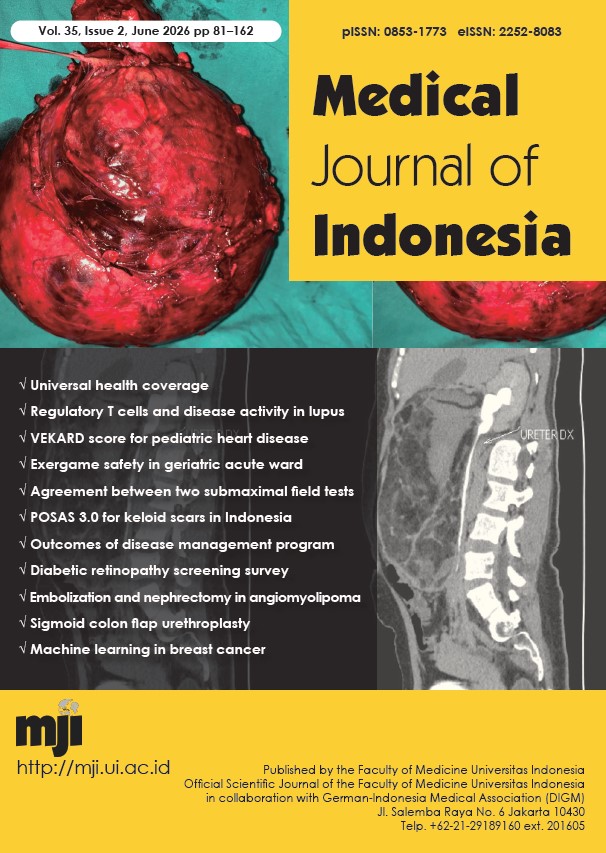
Medical Journal of Indonesia

1992  (1,  1)  to  Present  ISSN: 0853-1773

Articles

About

Save Email

Sort by

Best match
Relevance
PubYear
JournalTitle

DISPLAY OPTIONS

Format:

Per page:

Save citations to file

Selection:

Format:

Create file Cancel

Email citations

To:

Please check your email address first!

Selection:

Format:

Send email Cancel

21

results

page

of 3

1

Cite

Cite

Copy

Share

Share

Copy

Universal health coverage in an era of rising costs: Prevention and quality must move together

Felix Firyanto Widjaja

Medical Journal of Indonesia.2026;35(2):81-82. doi:https://doi.org/10.13181/mji.ed.268875

[No abstract available]
Editorial

Editorial

2

Cite

Cite

Copy

Share

Share

Copy

CD4⁺CD25⁺FOXP3⁺ Tregs and systemic lupus erythematosus disease activity among systemic lupus erythematosus patients

Nurul Ramadhani Umareta ; Yuniza ; Legiran ; Nova Kurniati ; Eddy Mart Salim

Medical Journal of Indonesia.2026;35(2):83-90. doi:https://doi.org/10.13181/mji.oa.268308

BACKGROUND : Systemic lupus erythematosus (SLE) is a chronic autoimmune disorder that impacts several organ systems. Regulatory T cells (Tregs) are essential for maintaining immunological tolerance, and their dysregulation has been found linked to the pathogenesis of SLE. This study aimed to evaluate the correlation between CD4⁺CD25⁺FOXP3⁺ Treg levels and disease activity, as measured by the MEX-SLEDAI score, in patients with SLE. METHODS : A cross-sectional study was conducted involving 40 SLE patients treated in the Allergy and Immunology outpatient clinic and inpatient ward of Mohammad Hoesin Hospital from June 1, 2024 to August 31, 2024. Inclusion criteria were adults (≥18 years) diagnosed with SLE who provided informed consent. Exclusion criteria included other history autoimmune or immunocompromised conditions, pregnancy or lactation, hormonal contraceptive use, and active severe infection. CD4⁺CD25⁺FOXP3⁺ Treg cell levels were measured by flow cytometry. Disease activity was assessed using the MEX-SLEDAI score. Spearman’s correlation test was used to analyze the association between Treg levels and disease activity. RESULTS : Of 40 enrolled subjects (39 women, 1 man), 75% were aged 20–44 years. Mucocutaneous manifestations were the most common clinical feature (95%). Nephritis and hematologic involvement were most frequently observed in patients with severe disease activity. A strong negative correlation was identified between CD4⁺CD25⁺FOXP3⁺ Treg cell levels and MEX-SLEDAI scores (R = –0.72, p<0.001), indicating that lower Treg levels were associated with higher disease activity. CONCLUSIONS CD4⁺CD25⁺FOXP3⁺ Treg levels show a significant negative correlation with MEX-SLEDAI disease activity in SLE. Lower Treg cell levels reflect more severe disease activity.
disease progression ; flow cytometry ; systemic lupus erythematosus ; Treg cells

disease progression ; flow cytometry ; systemic lupus erythematosus ; Treg cells

3

Cite

Cite

Copy

Share

Share

Copy

VEKARD score: clinical scoring system of pediatric heart disease for screening

Ni Putu Veny Kartika Yantie ; Eka Gunawijaya ; Lisa Amelia Wijaya ; Indah Kartika Murni

Medical Journal of Indonesia.2026;35(2):91-98. doi:https://doi.org/10.13181/mji.oa.258153

BACKGROUND : Heart disease in children is frequently diagnosed late in life. This study aimed to establish and validate a scoring system to screen for heart disease in children, based on clinical examinations to accelerate referral. METHODS : This 2-phase cross-sectional study was conducted in pediatric cardiology outpatients and emergency room Ngoerah Hospital, Bali, Indonesia, from January to May 2024 and July to October 2024. Children aged 0–18 who were suspected of having heart disease and willing to be research participants were included in this study. Patients who had already been diagnosed with heart disease and acute lower respiratory tract infection were excluded from the study. The chi-square, multivariate logistic regression, and ROC analysis were performed to identify and validate variables eligible for the scoring system. Phase 1 for generating the score, continued to phase 2 to validate the developed score. RESULTS : Of 310 patients enrolled, 15 were excluded from the study. Congenital heart disease was the dominant condition in this study. The first model of the scoring system, named VEKARD score, consisted of a significant murmur, exercise intolerance, difficulty in breathing, and SpO2 <95%. The second model replaced SpO2 <95% with cyanosis, which can be used if pulse oximetry is not available. Using a sensitivity-first threshold suitable for screening purposes, a cutoff ≥1 for model 1 and cutoff ≥2 for model 2 yielded sensitivities of 85% and 81.8%, respectively. Both models underwent validation in a sample of 241 patients. The results demonstrated good discriminative performance, with AUC values of 0.859 for model 1 and 0.853 for model 2. CONCLUSIONS The VEKARD score can be used to enhance pediatric heart disease screening and accelerate referral to tertiary healthcare facilities, thereby preventing delays in treatment.
children ; heart disease ; heart murmur ; prediction ; score

children ; heart disease ; heart murmur ; prediction ; score

4

Cite

Cite

Copy

Share

Share

Copy

Cardiovascular response and safety of virtual reality exergame in acute geriatric ward

Melinda Harini ; Widjajalaksmi Kusumaningsih ; Prasandhya Astagiri Yusuf ; Kuntjoro Harimurti ; Martina Wiwie Setiawan Nasrun ; Alida Rowsita Harahap ; Irma Ruslina Defi ; Satyanaya Widyaningrum ; Luthfi Saiful Arif ; Arierta Pujitresnani ; Boya Nugraha

Medical Journal of Indonesia.2026;35(2):99-106. doi:https://doi.org/10.13181/mji.oa.268209

BACKGROUND : Exergames have been proven to effectively improve physical function, particularly in the elderly. Although, older adults were once considered a low-tech population, tailored exergame interventions have proven beneficial. However, utilizing virtual reality (VR) in group presents challenges related to both cognitive acceptance and cardiovascular tolerance. This study aimed to evaluate cardiovascular responses, safety, and exercise intensity or VR-based exergaming in an acute care setting and to explore what to consider when giving exergames to subjects with high comorbidity. METHODS : This pre-post study used the Oculus Meta Quest 2® platform in 32 elderly participants. Each completed a single exergame session. Pre- and post-session assessments included measurements of heart rate (HR), systolic blood pressure (SBP), and diastolic blood pressure (DBP). Cardiopulmonary sentinel signs were monitored thoroughly. RESULTS : Post-exergame HR was significantly higher than baseline (82 [18] beats per minute [bpm] versus 79 [17] bpm; p = 0.004; mean difference: 4 [8] bpm). Blood pressure decreased slightly, but not significantly (SBP: −1 [14] mmHg, p = 0.837; DBP: 0 [12] mmHg, p = 0.829). Most participants experienced light-intensity activities (n = 26, 81%). No sentinel events occurred. CONCLUSIONS A single session of VR exergaming safely increased HR above baseline in elderly participants, with activity predominantly classified as light intensity. Further studies should explore the determinants of exergame intensity to optimize prescriptions and tailoring.
elderly ; exergames ; heart rate ; virtual reality

elderly ; exergames ; heart rate ; virtual reality

5

Cite

Cite

Copy

Share

Share

Copy

Assessing agreement between six-minute walk test and the incremental shuttle walk test in healthy sedentary adults

Anindira Rustandi ; Nury Nusdwinuringtyas ; Nurul Paramita ; Retno Asti Werdhani

Medical Journal of Indonesia.2026;35(2):107-114. doi:https://doi.org/10.13181/mji.oa.268128

BACKGROUND : The incremental shuttle walk test (ISWT) and six-minute walk test (6MWT) assess cardiorespiratory endurance in sedentary populations, with the ISWT being externally paced and the 6MWT self-paced. This study aimed to evaluate whether both tests produce comparable cardiorespiratory responses. METHODS : 100 healthy sedentary adults (18–59 years) from Cipto Mangunkusumo Hospital completed both tests. Outcomes measured included distance traveled, maximal heart rate (HRmax), and Borg scale scores (rating of perceived exertion [RPE], dyspnea, and leg fatigue). RESULTS : Of 100 sedentary adults (25 men, 75 women), the ISWT resulted in significantly longer walking distances (p<0.001), higher post-test Borg dyspnea scores (median [interquartile range]: 2 [1–3]) versus 1 [0–2]; p = 0.024), and the higher HRmax (70.9 [9.2%] bpm versus 67.9 [10.9%] bpm; p = 0.004) compared to the 6MWT. No significant differences were observed in other parameters, and Bland–Altman analysis revealed no proportional bias for Borg leg fatigue scores (p = 0.561). CONCLUSIONS In healthy sedentary adults, the 6MWT and ISWT showed no agreement in distance traveled, Borg dyspnea scale scores, or HRmax, but they agreed on Borg leg fatigue scores.
exercise test ; exercise tolerance ; incremental shuttle walk test ; physical fitness ; six-minute walk test

exercise test ; exercise tolerance ; incremental shuttle walk test ; physical fitness ; six-minute walk test

6

Cite

Cite

Copy

Share

Share

Copy

Cultural adaptation and validation of patient and observer scar assessment scale 3.0 for keloid scar assessment in Indonesian language

Yuni Eka Anggraini ; Niken Trisnowati ; Ronny Martien ; Triasari Oktavriana ; Thianti Sylvinigrum ; Erwin Setyo Nugroho ; Retno Danarti

Medical Journal of Indonesia.2026;35(2):115-124. doi: https://doi.org/10.13181/mji.oa.268447

BACKGROUND: Keloid, a fibroproliferative skin disorder, requires accurate scar assessment. Comprehensive evaluation using a standardized instrument from both patient and observer perspectives is essential to capture its multidimensional impact. This study aimed to translate, culturally adapt, and validate the generic patient and observer scar assessment scale (POSAS) 3.0 into Indonesian for keloid assessment. METHODS: A cross-sectional design was adopted following the translation and cultural adaptation guidelines. The instrument was translated into Indonesian by certified translators and administered to 68 keloid patients and 62 dermatologists especially recruited from Pekanbaru and the surrounding areas. Content validity was assessed using the scale-level content validity index average (S-CVI/Ave), construct validity through exploratory factor analysis (EFA), internal consistency with Cronbach’s alpha, test-retest reliability using the intraclass correlation coefficient (ICC), and external validity by correlating the observer scar assessment scale (OSAS) with the modified Vancouver scar scale (mVSS). RESULTS : The Indonesian version of the generic POSAS 3.0 demonstrated strong psychometric properties. The S-CVI/Ave was 0.97. The EFA revealed 3 factors for the patient scar assessment scale and two for the OSAS, explaining 71.25% and 73.1% of the variance, respectively. Cronbach’s alpha was 0.79–0.90 and ICC was ≥0.83. External validity was confirmed by a strong correlation with the mVSS (Spearman’s rho = 0.82, p<0.001). CONCLUSIONS The Indonesian adaptation of the POSAS 3.0 is a valid and reliable tool for comprehensive keloid scar assessment. Future research should explore the responsiveness to therapeutic interventions.
Indonesia ; keloid ; psychometrics ; reproducibility of results ; validation study

Indonesia ; keloid ; psychometrics ; reproducibility of results ; validation study

7

Cite

Cite

Copy

Share

Share

Copy

Health-related outcomes of chronic disease management program for diabetes mellitus in the Indonesian Eastern border region

Wynne Widiarti ; Sovia Salamah ; Feriawan Tan ; Julian Benedict Swannjo ; Muhammad Afif Shofwan Fa' ; iq ; Anastasia Anita Rusli ; Aisya Ayu Shafira ; Rachmadianti Sukma Hanifa ; Fauzan Illavi ; Bustanul Arifin ; Astri Dewayani ; Firas Farisi Alkaff

Medical Journal of Indonesia.2026;35(2):125-132. doi:https://doi.org/10.13181/mji.oa.268179

BACKGROUND : The Indonesian chronic disease management program (PROLANIS) was introduced to provide structured chronic disease management for hypertension and type 2 diabetes (T2D) at the primary healthcare level. This study aimed to evaluate the health-related outcomes of PROLANIS among T2D patients in the eastern border region. METHODS : This retrospective cohort study used secondary data from PROLANIS reports of all primary healthcare facilities in Atambua Regency, East Nusa Tenggara Province, Indonesia. Inclusion criteria were all T2D patients who participated in routine 6-month evaluations conducted between June 2023 and December 2023. The assessed parameters and their defined targets were body mass index (BMI) (18.5–23 kg/m²), systolic blood pressure (SBP) (<140 mmHg), diastolic blood pressure (DBP) (<90 mmHg), hemoglobin A1c (HbA1c) (<7%), total cholesterol (TC) (<200 mg/dl), high-density lipoprotein (HDL) (>40 mg/dl for males and >50 mg/dl for females), low-density lipoprotein (LDL) (<100 mg/dl), and triglycerides (TGs) (<150 mg/dl). Wilcoxon signed-rank and paired t-tests were used for statistical analyses. RESULTS : There were 51 T2D patients included in the analyses. Of these, 84% achieved SBP and 96% achieved DBP targets. However, only 45% achieved HbA1c, and 33% achieved BMI targets. For lipid profiles, 55%, 51%, 47%, and 41% achieved TC, LDL, HDL, and TG targets, respectively. No significant differences were found between baseline and follow-up across these parameters (all p>0.05). CONCLUSIONS In the border region, while PROLANIS maintains blood pressure levels, it does not significantly improve other health-related outcomes in T2D patients. This underscores the need to strengthen program intensity, support adherence, and address contextual barriers to achieve meaningful metabolic improvements.
chronic disease ; government programs health services ; Indonesia ; primary healthcare ; type 2 diabetes mellitus

chronic disease ; government programs health services ; Indonesia ; primary healthcare ; type 2 diabetes mellitus

8

Cite

Cite

Copy

Share

Share

Copy

Indonesian client satisfaction questionnaire-18 for evaluating AI-assisted diabetic retinopathy screening in primary care: reliability and patient satisfaction

Yeni Dwi Lestari ; Ratna Sitompul ; Indah Suci Widyahening ; Dicky Levenus Tahapary ; Prasandhya Astagiri Yusuf ; Muhammad Bayu Sasongko ; Pandu Riono ; Gratcheva Alexandra ; Aritha Wulan ; Handhika Dhio ; Saleha Sungkar ; Clifford Attkisson

Medical Journal of Indonesia.2026;35(2):133-140. doi:https://doi.org/10.13181/mji.oa.268503

BACKGROUND : Diabetic retinopathy (DR) is a leading cause of preventable blindness. However, Indonesia lacks a comprehensive screening program. Artificial intelligence (AI)-assisted screening in primary health care (PHC) is a promising solution. Patient satisfaction is crucial for ensuring the participation and sustainability of such programs. This study aimed to adapt Indonesian version of evaluate client satisfaction questionnaire-18 (CSQ-18) and evaluate its acceptability. METHODS : This study was conducted from August 5–29, 2024 at 2 public PHCs in Jakarta. Patients with diabetes underwent DR screening, which included fundus photography and an AI-based grading system (RADR). Referable cases were graded secondarily by ophthalmologists. Satisfaction was assessed from November 10–20, 2024 using the Indonesian-translated CSQ-18, adapted through forward-backward translation, expert review, and pilot testing. Reliability was assessed using Cronbach’s alpha, validity was evaluated using Pearson’s correlation, and satisfaction scores were summarized as descriptive statistics. RESULTS : Of 300 selected participants, 216 completed telephone or in-person interviews. The Indonesian CSQ-18 demonstrated a strong internal consistency (Cronbach’s alpha = 0.886). All items showed acceptable item-total correlations. The mean (SD) satisfaction score was 60.19 (5.50) of 72, with a median of 59, indicating high patient satisfaction. Most participants expressed positive perceptions of screening duration, accessibility, and provider competence, although awareness-related items scored slightly lower. Potential interviewer bias and nonresponse may have affected the findings. CONCLUSIONS The Indonesian CSQ-18 is a reliable tool for assessing patient satisfaction with DR screening. These findings confirm the feasibility and acceptability of AI-assisted DR screening at the PHC level, supporting its potential for broader implementation in Indonesia.
artificial intelligence ; diabetic retinopathy ; patient satisfaction ; primary health care ; surveys and questionnaires

artificial intelligence ; diabetic retinopathy ; patient satisfaction ; primary health care ; surveys and questionnaires

9

Cite

Cite

Copy

Share

Share

Copy

Angioembolization followed by nephrectomy for giant renal angiomyolipoma in a 30-year-old woman: a case report

Akhmad Miftahudin Fazri ; Her Bayu Widyasmara ; Indra Raymond

Medical Journal of Indonesia.2026;35(2):141-146. doi: https://doi.org/10.13181/mji.cr.268210

Renal angiomyolipoma (AML) is a benign renal tumor that can grow significantly and cause complications, such as hemorrhage and pain, necessitating active intervention. Managing giant AML in young women remains challenging, and evidence for multimodal approaches is limited. This case report describes the management of a giant AML by selective renal angioembolization (RAE) followed by total nephrectomy. A 30-year-old woman presented with an 18 × 20 × 22 cm AML, resulting in bleeding and kidney dysfunction. Total nephrectomy was performed after stabilization with RAE. This multimodal approach reduces surgical risk and preserves renal function. Combining RAE with nephrectomy shows promise for treating complex giant AML and warrants further research to optimize the technique and assess the long-term outcomes.
angiomyolipoma ; nephrectomy ; women

angiomyolipoma ; nephrectomy ; women

10

Cite

Cite

Copy

Share

Share

Copy

Sigmoid colon flap for urethroplasty in bulbar spongionecrosis: a case report

Rinaldo Indra Rachman ; Indah Jamtani ; Amrizal Umran ; Yonas Immanuel Hutasoit ; Syamsu Hudaya ; Firtantyo Adi Syahputra ; Maulidina Medika Rahmita ; Caesar Khairul Wallad

Medical Journal of Indonesia.2026;35(2):147-150. doi:https://doi.org/10.13181/mji.cr.268272

Bulbar urethral ischemic necrosis (BUIN) is an unfortunate complication of urethroplasties. This is a result of previous unsalvageable strictures resulting from previous repairs. Here, we present the first case of entero-urethroplasty performed using a sigmoid flap. A 27-year-old man visited the urology clinic with a complaint of urine retention on cystostomy 1 year prior. He had a motor vehicle accident that injured the urethra. He had previously undergone excision and primary anastomosis (EPA) urethroplasty and redo EPA; however, the results were unsatisfactory. Entero-urethroplasty was performed using a sigmoid colon flap harvested carefully from the patient's sigmoid colon, and reconstructive options are limited to BUIN. The sigmoid flap reconstruction appears for treating BUN. This study's limitation is the short follow-up period. Therefore, further studies and long-term follow-up should be performed to assess the effectiveness of this technique.
sigmoid ; stricture ; urethra ; urethroplasty

sigmoid ; stricture ; urethra ; urethroplasty

Country

Indonesia

Publisher

Faculty of Medicine Universitas Indonesia

ElectronicLinks

https://mji.ui.ac.id/

Editor-in-chief

Agus Rizal A. H. Hamid

E-mail

mji@ui.ac.id

Abbreviation

Med J Indones

Vernacular Journal Title

Medical Journal of Indonesia

ISSN

0853-1773

EISSN

2252-8083

Year Approved

2026

Current Indexing Status

Currently Indexed

Start Year

1992

Description

Medical Journal of Indonesia is a peer-reviewed and open access journal that focuses on promoting medical sciences generated from basic sciences, clinical, and community or public health research to integrate researches in all aspects of human health. This journal publishes original articles, reviews, and also interesting case reports. Brief communications containing short features of medicine, latest developments in diagnostic procedures, treatment, or other health issues that is important for the development of health care system are also acceptable. Correspondence articles of our own published article are welcome.

Related Sites

WHO WPRO GIM

Help Accessibility
DCMS Web Policy
CJSS Privacy Policy

Powered by IMICAMS( 备案号: 11010502037788, 京ICP备10218182号-8)

Successfully copied to clipboard.